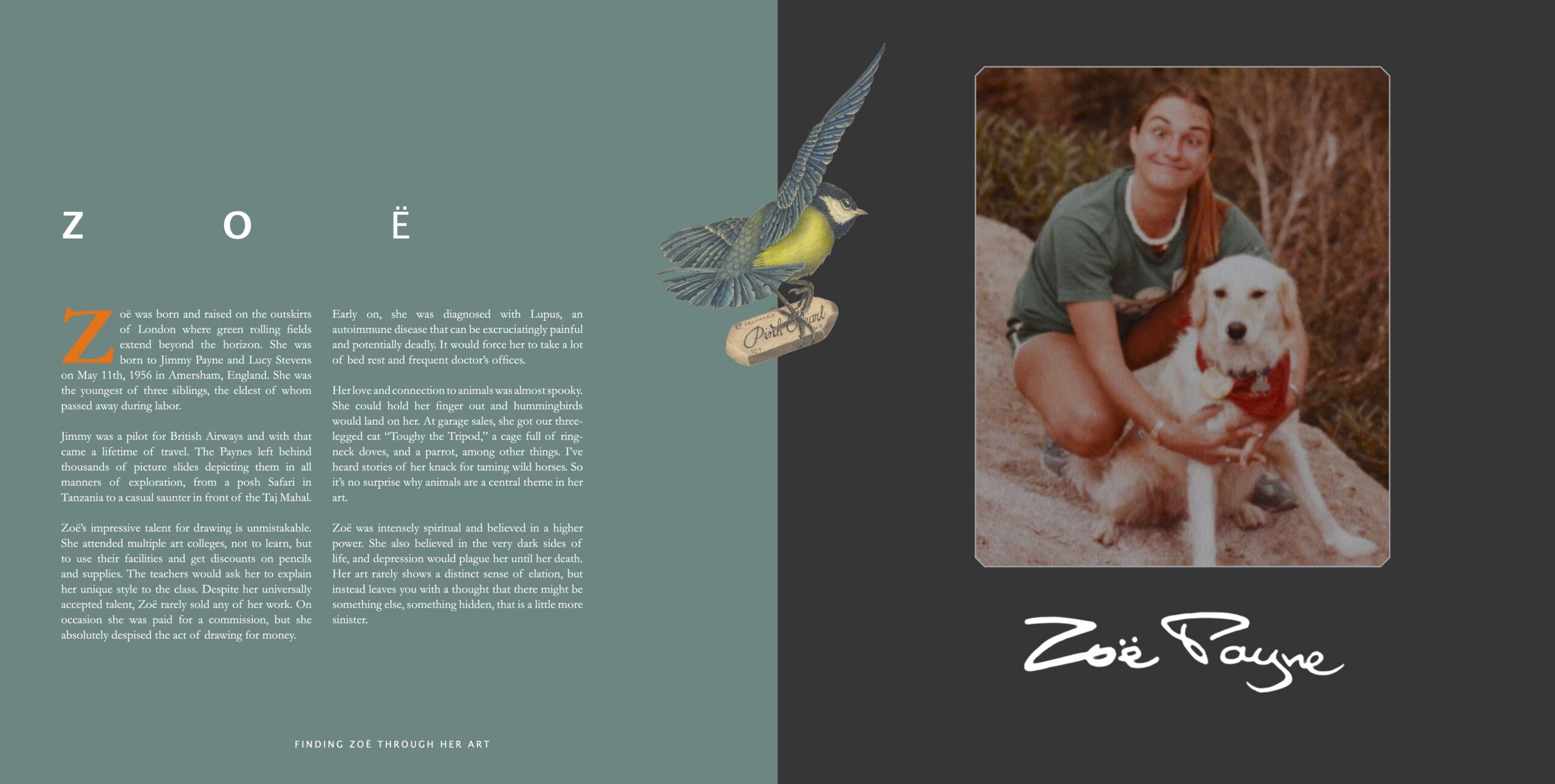
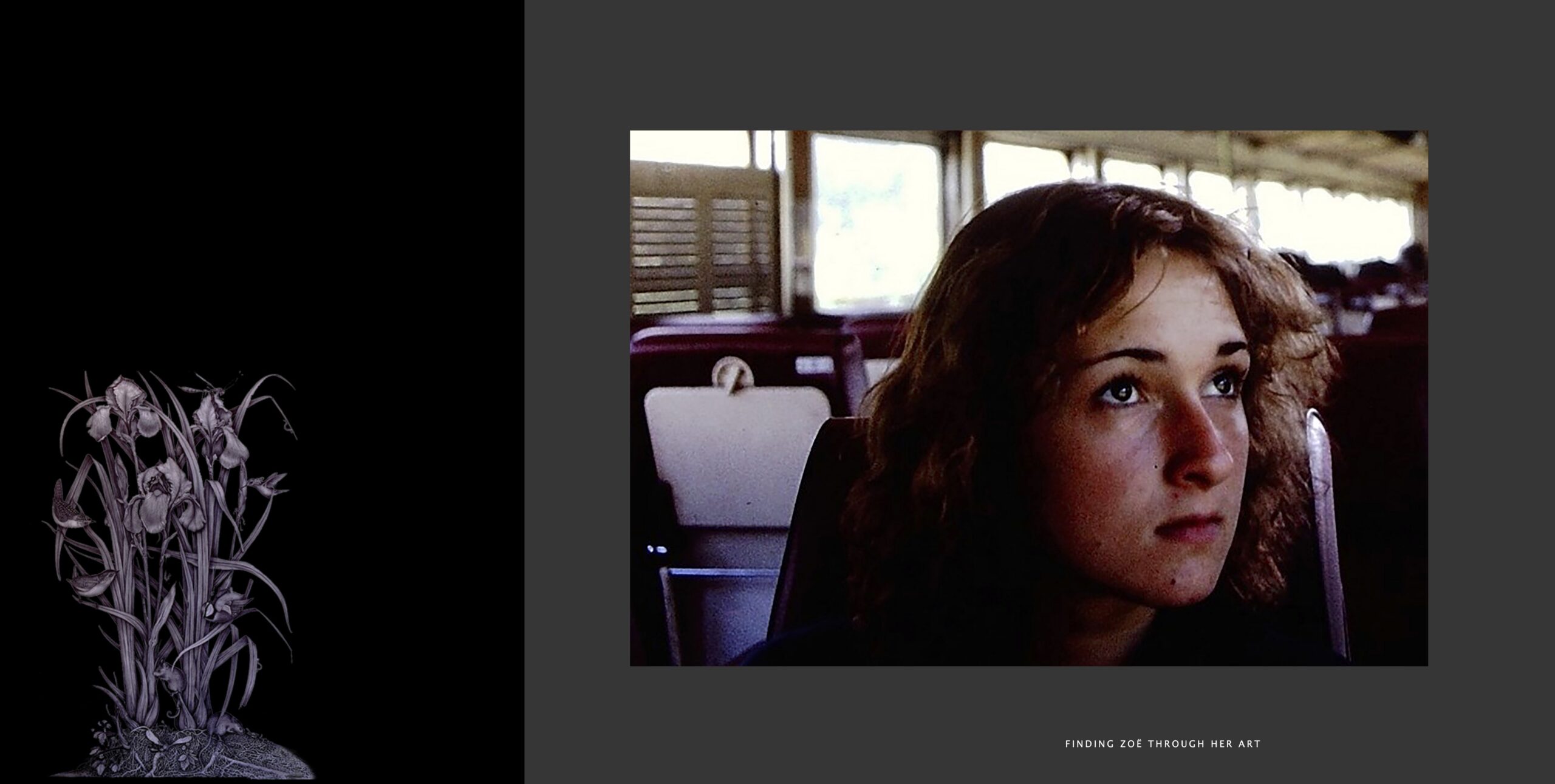
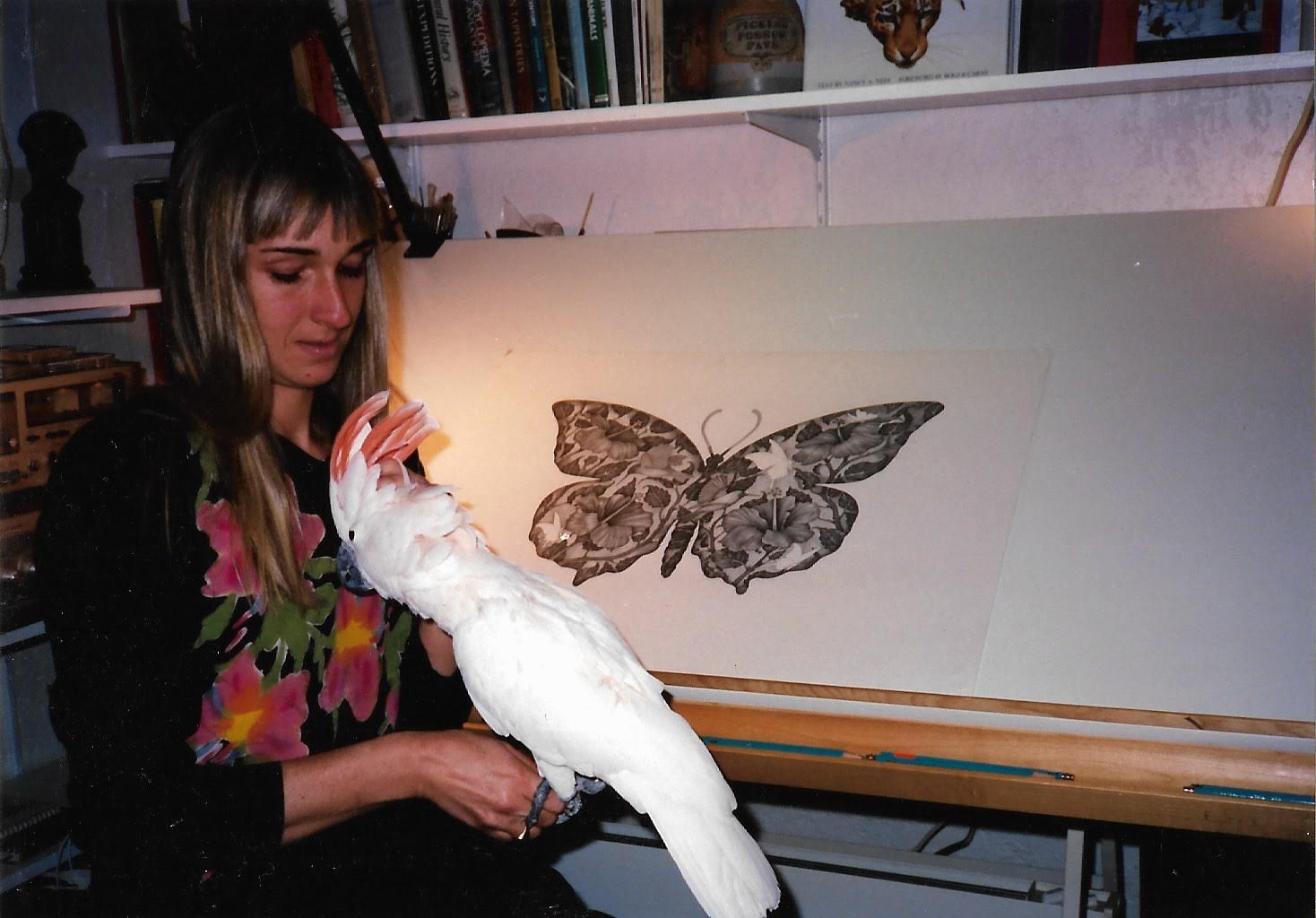
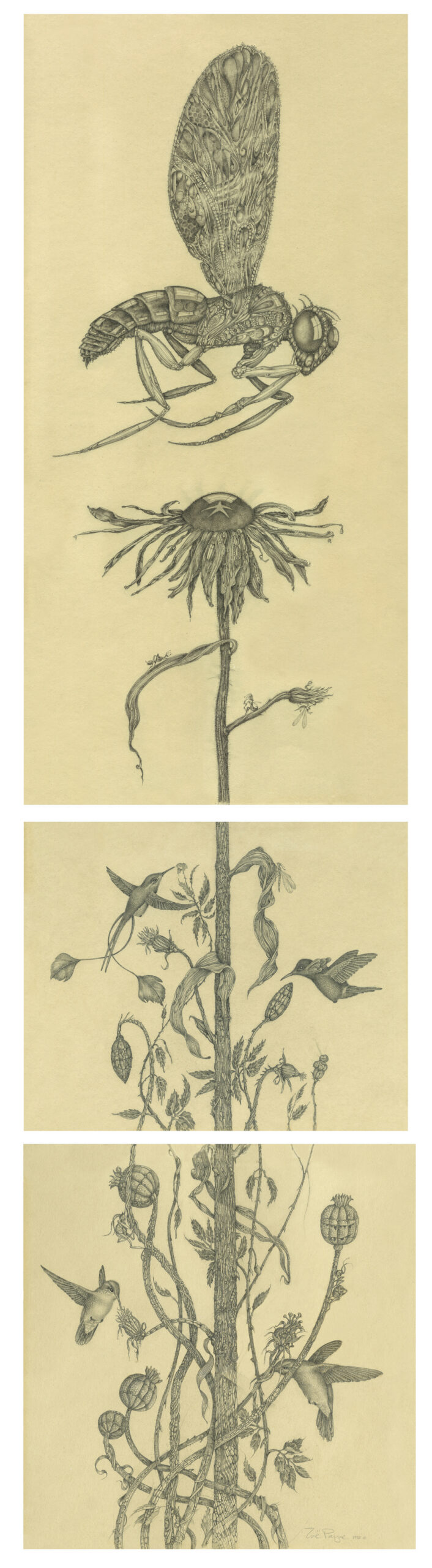
You cannot find someone you know nothing about. Before the journey, this chapter draws a portrait of Zoë Payne — her childhood in England, her art colleges, her animals, her Lupus, her darkness, and her extraordinary gift.
Zoë was born and raised on the outskirts of London where green rolling fields extend beyond the horizon. She was born to Jimmy Payne and Lucy Stevens on May 11th, 1956 in Amersham, England. She was the youngest of three siblings, the eldest of whom passed away during labor.
Jimmy was a pilot for British Airways and with that came a lifetime of travel. The Paynes left behind thousands of picture slides depicting them in all manners of exploration, from a posh Safari in Tanzania to a casual saunter in front of the Taj Mahal.
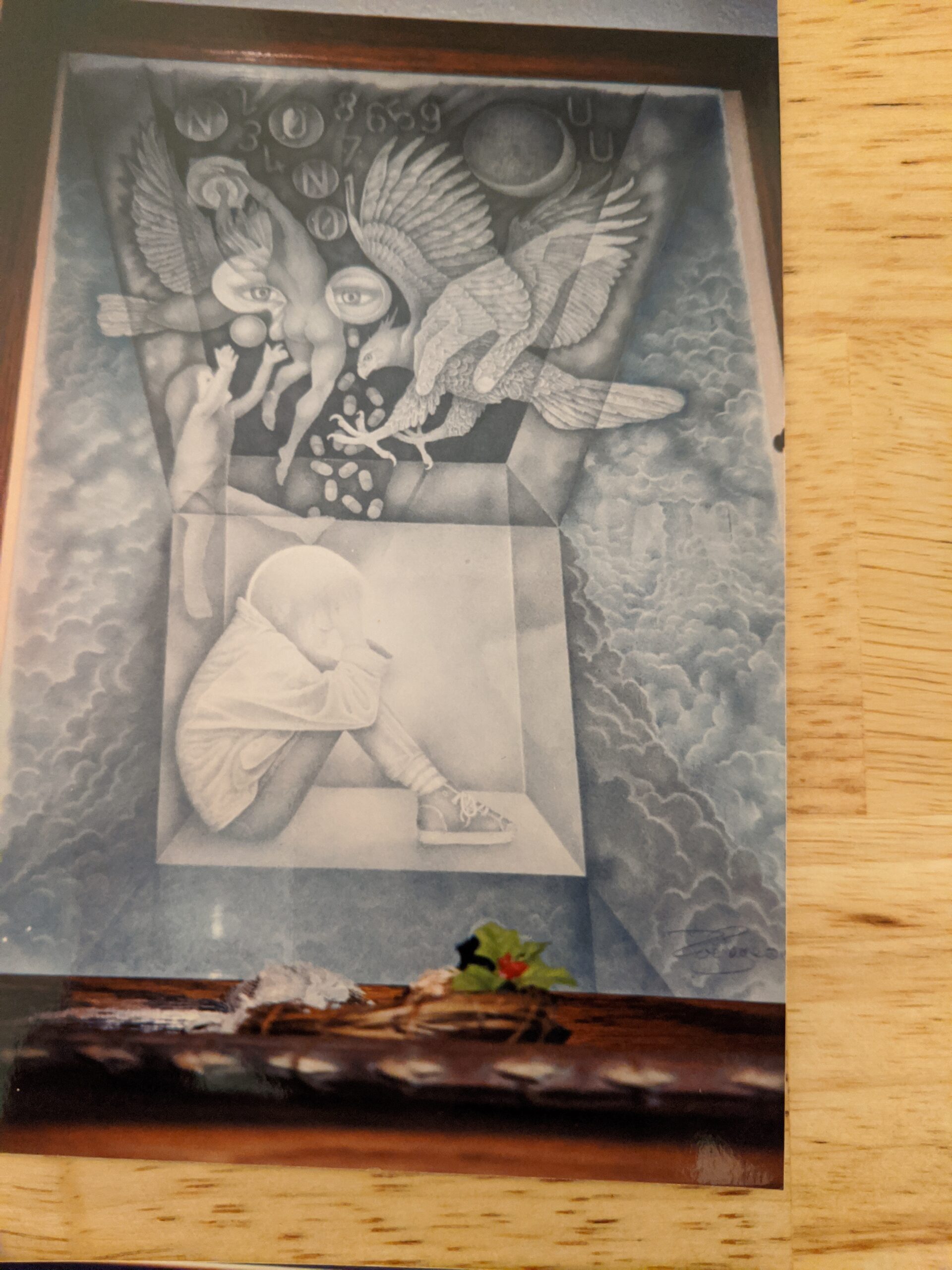
Zoë’s impressive talent for drawing is unmistakable. She attended multiple art colleges, not to learn, but to use their facilities and get discounts on pencils and supplies. The teachers would ask her to explain her unique style to the class. Despite her universally accepted talent, Zoë rarely sold any of her work. On occasion she was paid for a commission, but she absolutely despised the act of drawing for money.
Early on, she was diagnosed with Lupus, an autoimmune disease that can be excruciatingly painful and potentially deadly. It would force her to take a lot of bed rest and frequent doctor’s offices.
Her love and connection to animals was almost spooky. She could hold her finger out and hummingbirds would land on her. At garage sales, she got our three-legged cat “Toughy the Tripod,” a cage full of ring-neck doves, and a parrot, among other things. I’ve heard stories of her knack for taming wild horses. So it’s no surprise why animals are a central theme in her art.
Zoë was intensely spiritual and believed in a higher power. She also believed in the very dark sides of life, and depression would plague her until her death. Her art rarely shows a distinct sense of elation, but instead leaves you with a thought that there might be something else, something hidden, that is a little more sinister.
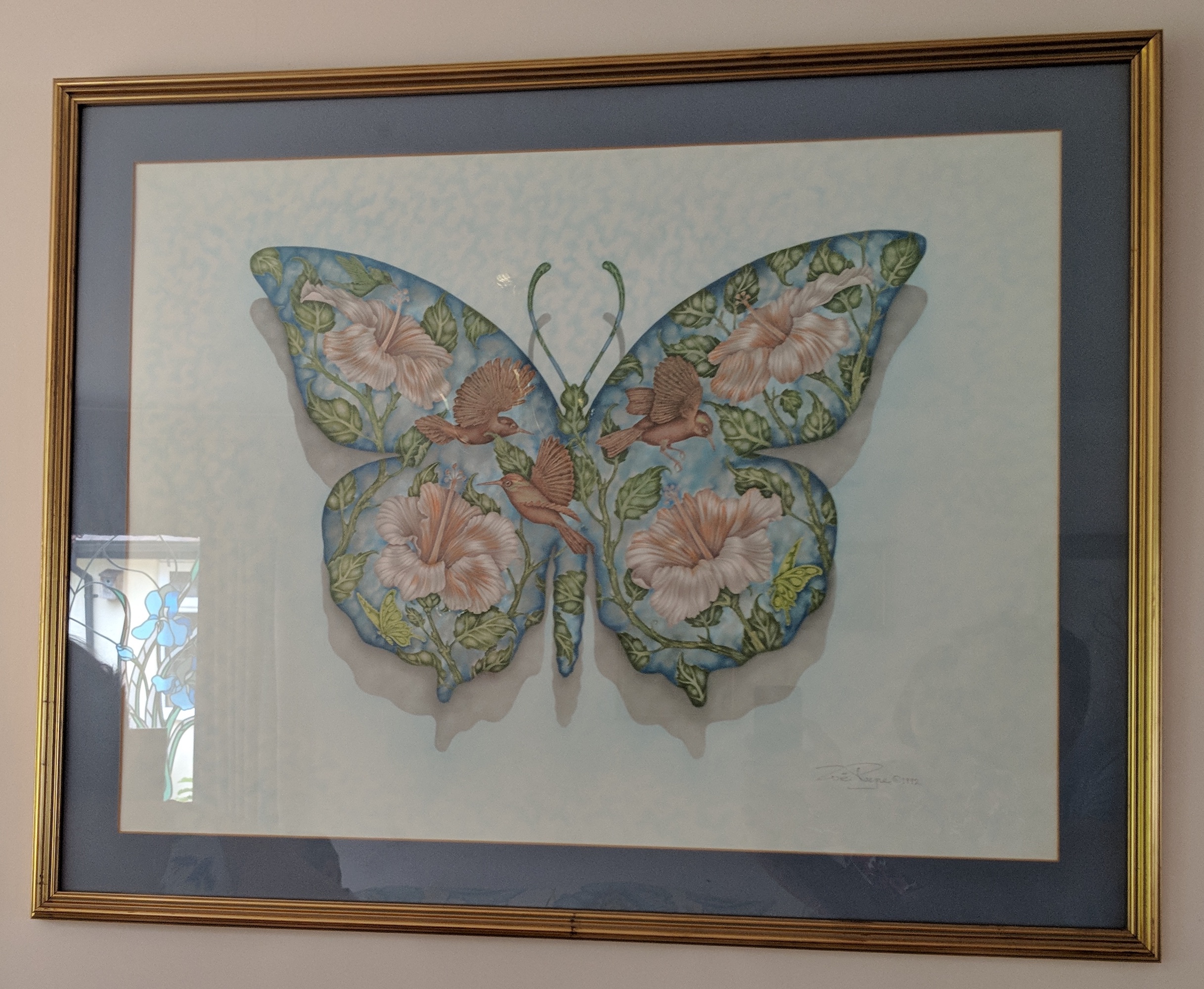
Two chapters, one folder. Crystal opened a print of a butterfly and began to cry. Then she took Luke upstairs to show him why. Vanessa is the reason Luke chose that particular picture to give away in the first place.
Crystal
On my way to Pat’s house to deliver the Woodpecker, I stopped for a night at the Harris household in Folsom, California. I got to know the Harris family when I crashed the memorial of their recently deceased grandmother and shared a number of teary-eyed drinks with their family.
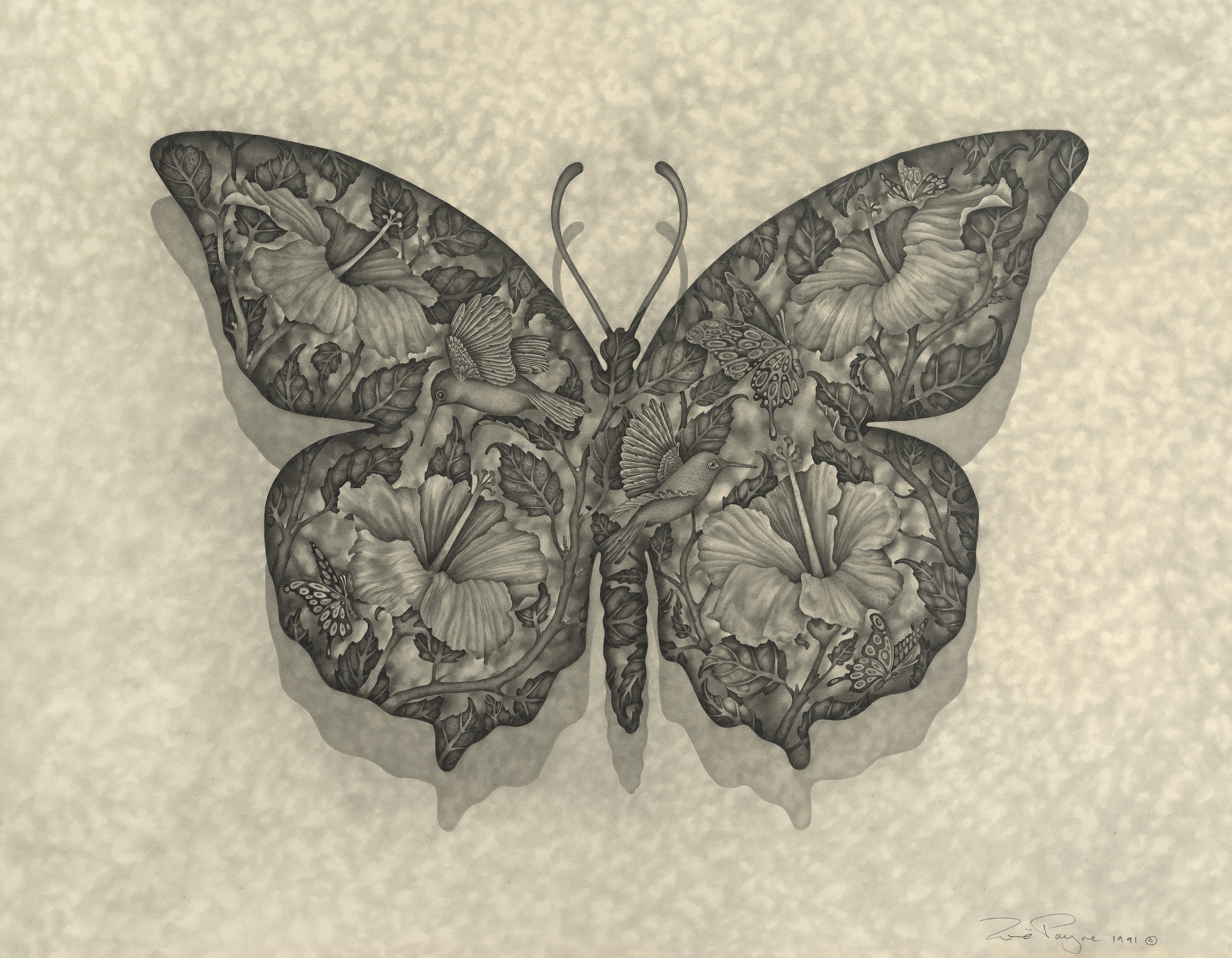
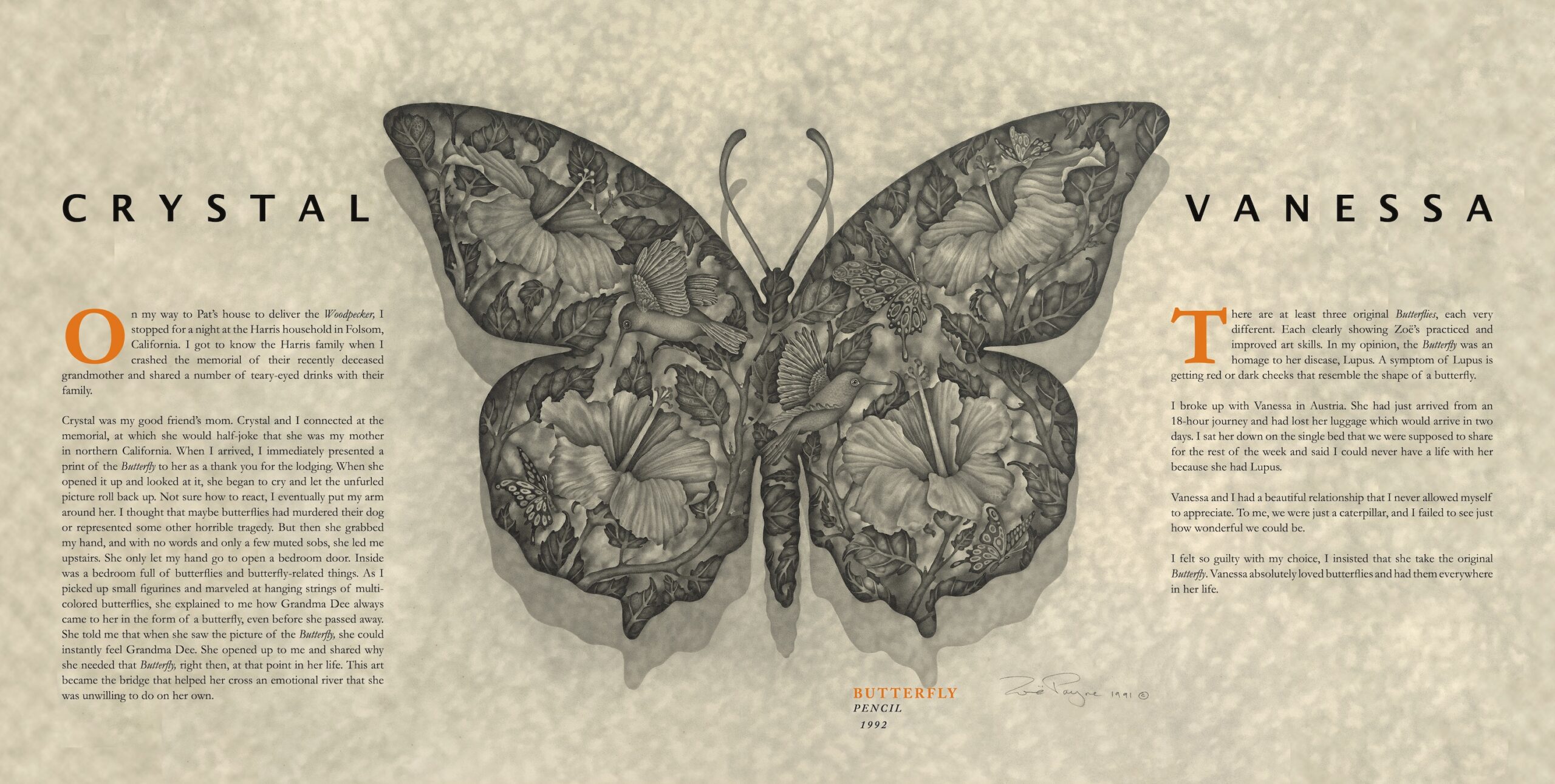
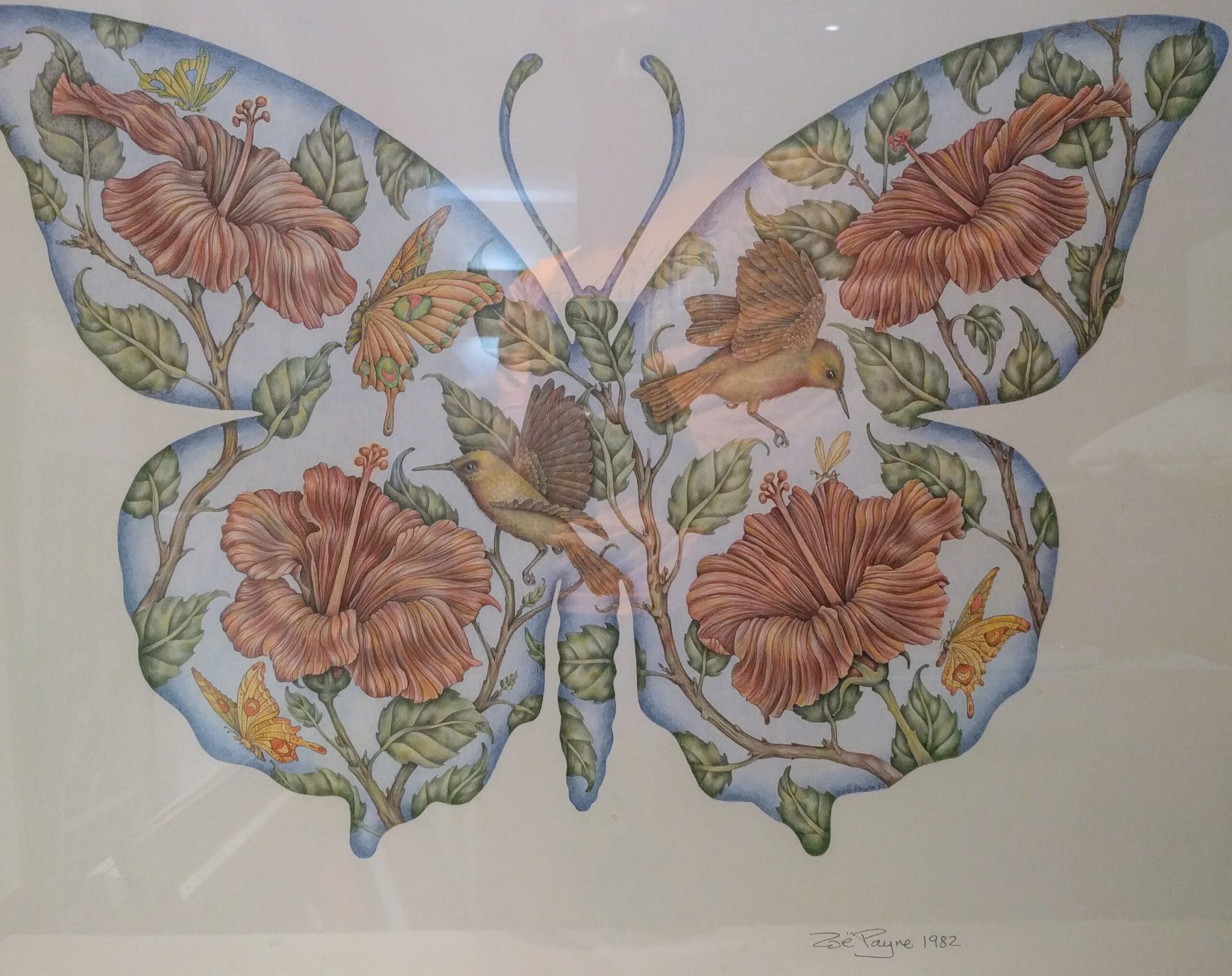
Crystal was my good friend’s mom. Crystal and I connected at the memorial, at which she would half-joke that she was my mother in northern California. When I arrived, I immediately presented a print of the Butterfly to her as a thank you for the lodging. When she opened it up and looked at it, she began to cry and let the unfurled picture roll back up. Not sure how to react, I eventually put my arm around her. I thought that maybe butterflies had murdered their dog or represented some other horrible tragedy. But then she grabbed my hand, and with no words and only a few muted sobs, she led me upstairs. She only let my hand go to open a bedroom door. Inside was a bedroom full of butterflies and butterfly-related things. As I picked up small figurines and marveled at hanging strings of multi-colored butterflies, she explained to me how Grandma Dee always came to her in the form of a butterfly, even before she passed away. She told me that when she saw the picture of the Butterfly, she could instantly feel Grandma Dee. She opened up to me and shared why she needed that Butterfly, right then, at that point in her life. This art became the bridge that helped her cross an emotional river that she was unwilling to do on her own.
Vanessa
There are at least three original Butterflies, each very different. Each clearly showing Zoë’s practiced and improved art skills. In my opinion, the Butterfly was an homage to her disease, Lupus. A symptom of Lupus is getting red or dark cheeks that resemble the shape of a butterfly.
I broke up with Vanessa in Austria. She had just arrived from an 18-hour journey and had lost her luggage which would arrive in two days. I sat her down on the single bed that we were supposed to share for the rest of the week and said I could never have a life with her because she had Lupus.
Vanessa and I had a beautiful relationship that I never allowed myself to appreciate. To me, we were just a caterpillar, and I failed to see just how wonderful we could be.
I felt so guilty with my choice, I insisted that she take the original Butterfly. Vanessa absolutely loved butterflies and had them everywhere in her life.
The longest chapter, and the most complicated visit. Cheri and Scott. Tequila and snow. Dark confessions and beautiful memories, told without filter by people who had always lived without one.
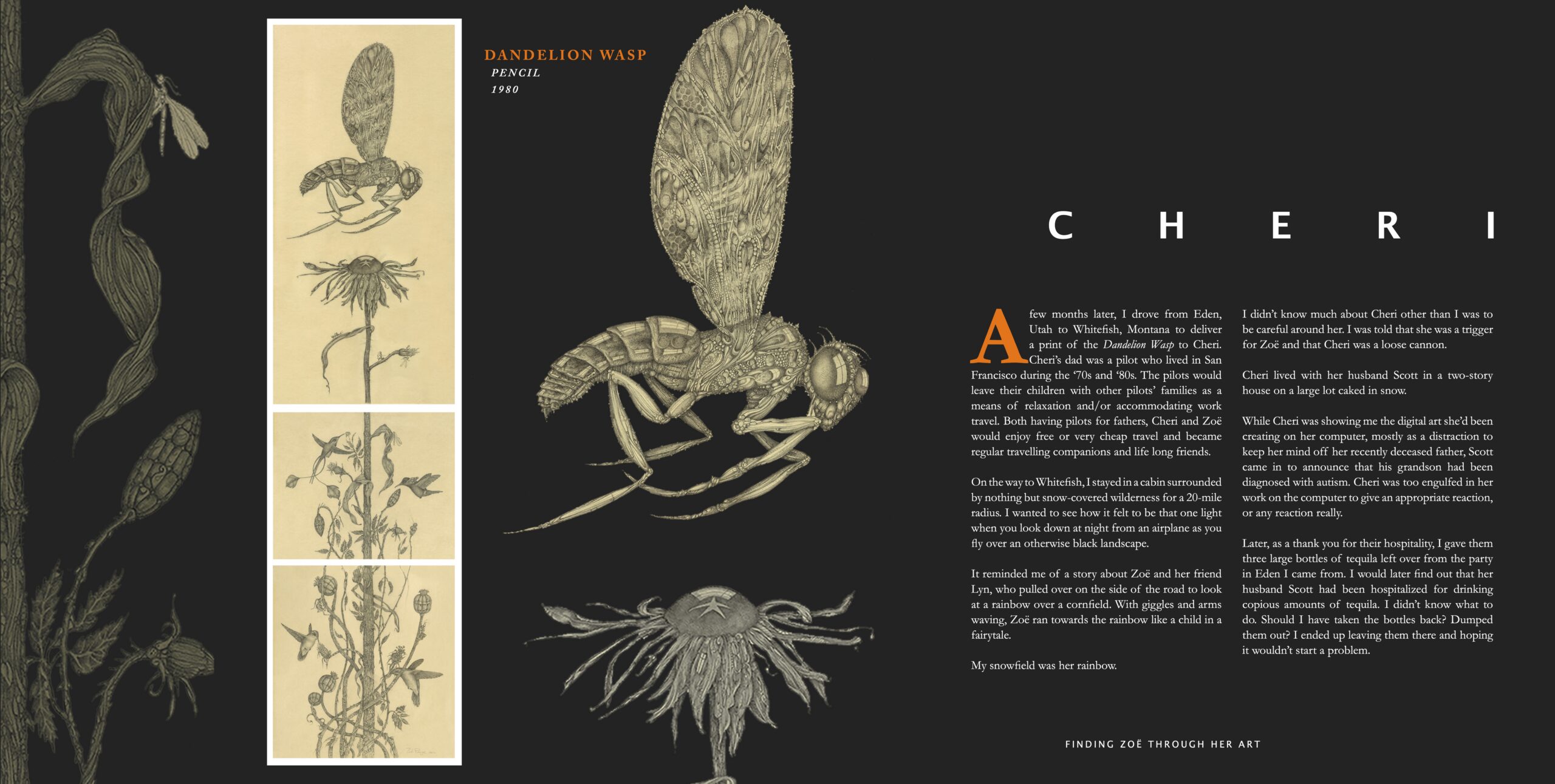
A few months later, I drove from Eden, Utah to Whitefish, Montana to deliver a print of the Dandelion Wasp to Cheri. Cheri’s dad was a pilot who lived in San Francisco during the ‘70s and ‘80s. The pilots would leave their children with other pilots’ families as a means of relaxation and/or accommodating work travel. Both having pilots for fathers, Cheri and Zoë would enjoy free or very cheap travel and became regular travelling companions and life long friends.
On the way to Whitefish, I stayed in a cabin surrounded by nothing but snow-covered wilderness for a 20-mile radius. I wanted to see how it felt to be that one light when you look down at night from an airplane as you fly over an otherwise black landscape.
It reminded me of a story about Zoë and her friend Lyn, who pulled over on the side of the road to look at a rainbow over a cornfield. With giggles and arms waving, Zoë ran towards the rainbow like a child in a fairytale.
My snowfield was her rainbow.
I didn’t know much about Cheri other than I was to be careful around her. I was told that she was a trigger for Zoë and that Cheri was a loose cannon.
Cheri lived with her husband Scott in a two-story house on a large lot caked in snow.
While Cheri was showing me the digital art she’d been creating on her computer, mostly as a distraction to keep her mind off her recently deceased father, Scott came in to announce that his grandson had been diagnosed with autism. Cheri was too engulfed in her work on the computer to give an appropriate reaction, or any reaction really.
Later, as a thank you for their hospitality, I gave them three large bottles of tequila left over from the party in Eden I came from. I would later find out that her husband Scott had been hospitalized for drinking copious amounts of tequila. I didn’t know what to do. Should I have taken the bottles back? Dumped them out? I ended up leaving them there and hoping it wouldn’t start a problem.
One morning, Scott and I went for a snowy walk around the neighborhood where we found ourselves in a serious heart-to-heart conversation despite only knowing each other for all of three hours. Me confessing my failing marriage, and he about his wife and regrettable decisions in life. Maybe that’s what made it easier – telling your deepest darkest secrets to a complete stranger. It was refreshing.
I asked Cheri about Zoë. She had many beautiful stories of her and Zoë traveling the world together and how close she had been with Zoë’s family. But she also had some very dark stories. She would describe herself walking into Zoë’s art room and seeing Zoë leaning over a bucket, cutting her forearms and letting the blood drip into it. I knew Zoë did this but had never seen it for myself. I’d only seen the aftermath, of white bandaged arms and slanted looks from neighbors.
On a trip to get a new router for Cheri and Scott, Cheri told me that she thought my dad killed my mom. I stared at the routers in front of me with a straight face just like I did when Scott announced his grandson was autistic. I eventually thanked her for her candor. In hindsight, I understand her theories. According to Cheri, Zoë was always worried about some girl named Barbrö, who was Dick’s brother’s ex-wife. Shortly after Zoë passing away, Dick married Barbrö.
I didn’t have the words to describe a lifetime of hardship and sacrifice my dad had dedicated to Zoë, but I knew Cheri’s allegation not to be true.
I found a note at the bottom of Zoë’s jewelry box. In typewriter font, it said:
I love you Zoë I want you to get better
I don’t care how long that takes I will do anything I can to help this happen I will never leave you I will make whatever changes to myself to make all the above happen Never give up but have patience But most important of all, I love you Zoë
(see you soon, Dicki Bird)
When I unfolded the note, a bloodstained razor fell out of it. Until then, everything about my mother and her thoughts seemed intangible and potentially a figment of my imagination. But picking up that razor made it all feel very real. I had visions of my mom digging it into her forearm while she read the note, maybe crying. I had visions of my dad struggling to know what to do, how to help, and this note being just one of the many ways he tried.
Before I left, I showed Scott and Cheri some slides I had scanned from Zoe’s travels to California. The slides showed Scott and Cheri with Zoë during their high school years doing high school things. Despite the psychological intensity of the last few days, these pictures brought a big calm to it all. As they viewed the pictures, I could feel them breathing life back into what was and what still could be.
Although filled with antics, I really enjoyed my time with Cheri and Scott. Their unedited and vigorous approach to life, love, and tragedy… was refreshing, and reminded me of myself.