This is where the journey begins — and where it was always going to end up. Before the hunt for pictures, before the ferry rides and road trips and strangers’ living rooms, there was a son who had never properly grieved his mother. This chapter is his introduction.
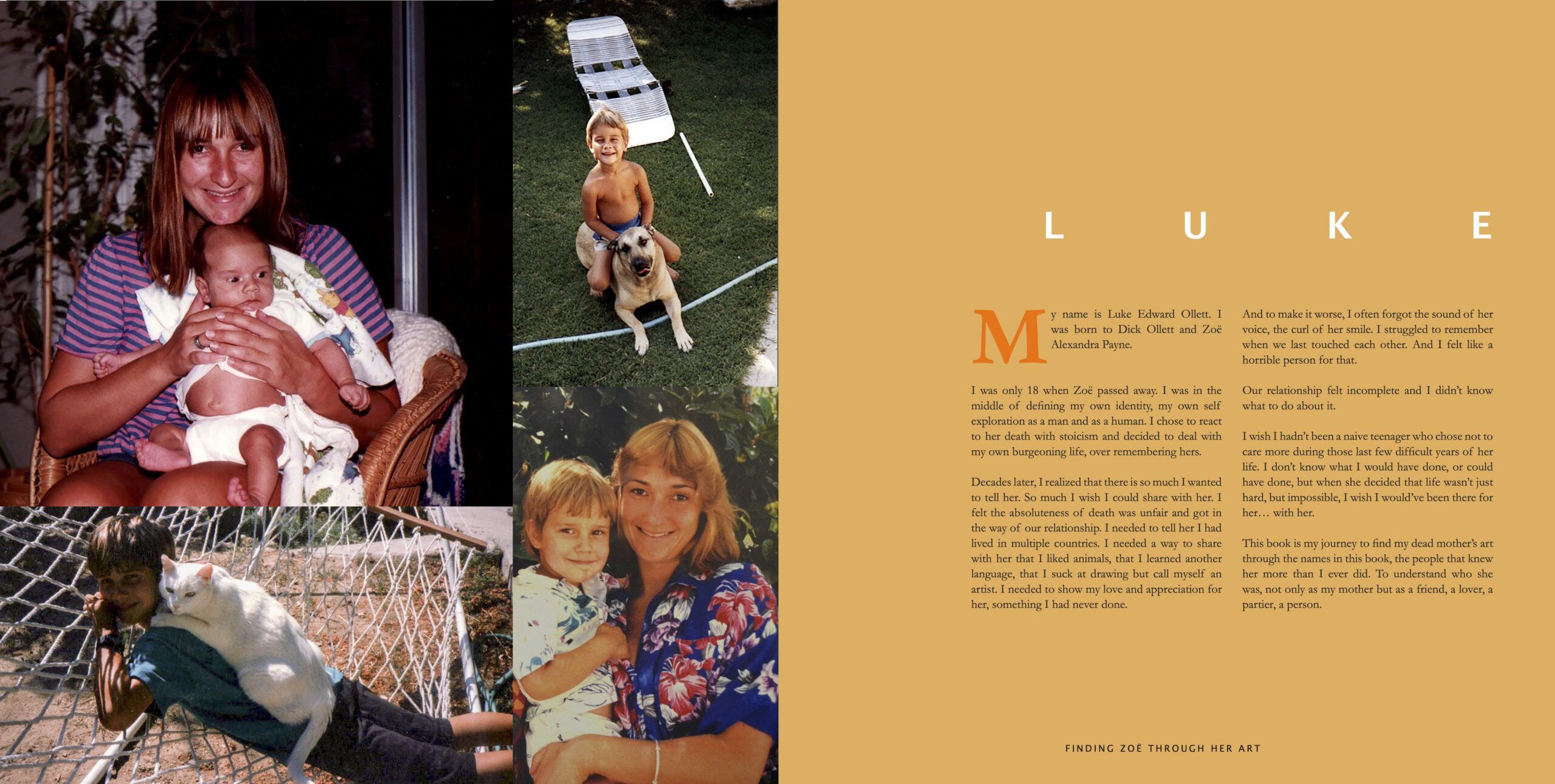
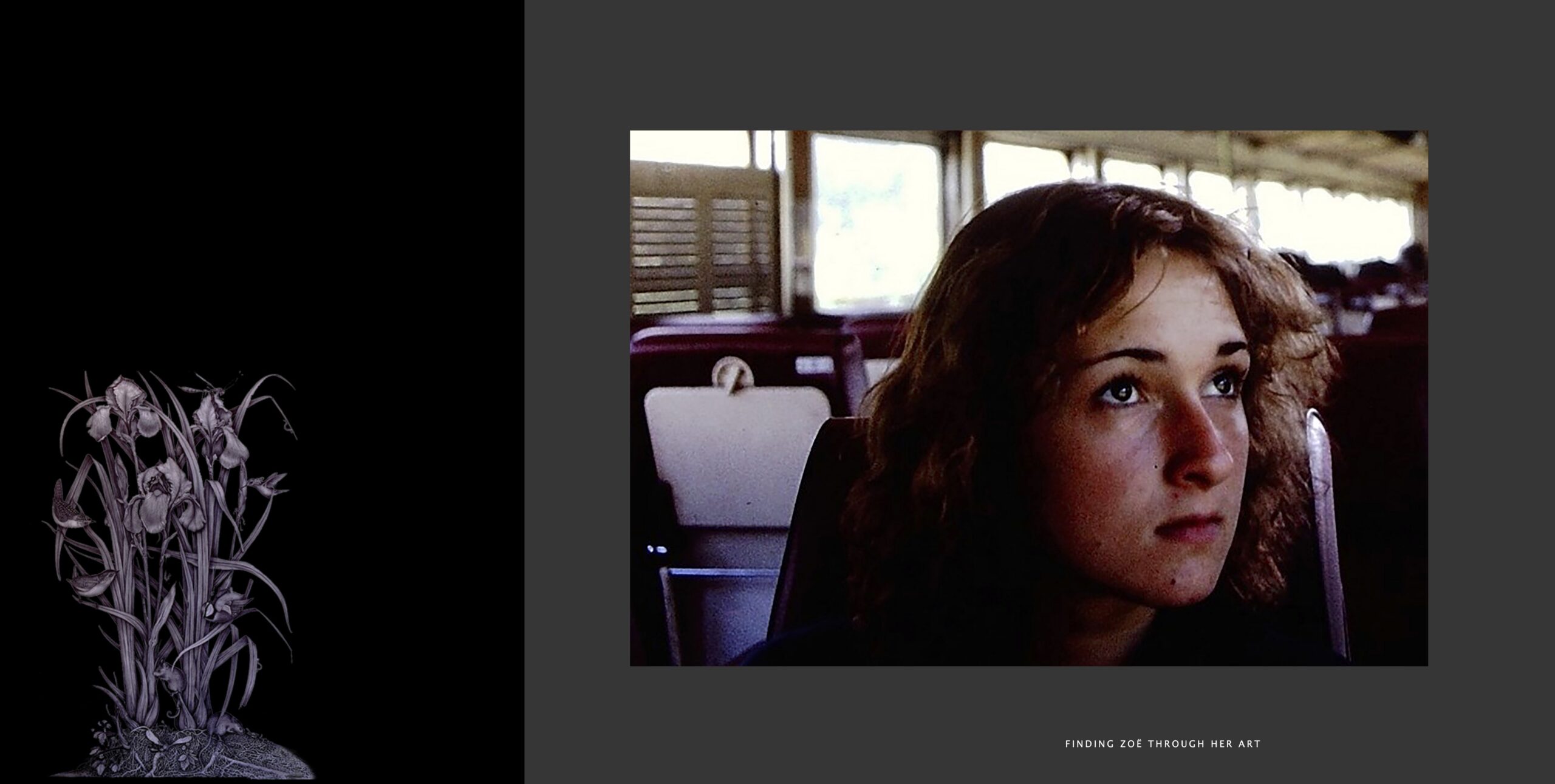
My name is Luke Edward Ollett. I was born to Dick Ollett and Zoë Alexandra Payne.
I was only 18 when Zoë passed away. I was in the middle of defining my own identity, my own self exploration as a man and as a human. I chose to react to her death with stoicism and decided to deal with my own burgeoning life, over remembering hers.
Decades later, I realized that there is so much I wanted to tell her. So much I wish I could share with her. I felt the absoluteness of death was unfair and got in the way of our relationship. I needed to tell her I had lived in multiple countries. I needed a way to share with her that I liked animals, that I learned another language, that I suck at drawing but call myself an artist. I needed to show my love and appreciation for her, something I had never done.
And to make it worse, I often forgot the sound of her voice, the curl of her smile. I struggled to remember when we last touched each other. And I felt like a horrible person for that.
Our relationship felt incomplete and I didn’t know what to do about it.
I wish I hadn’t been a naive teenager who chose not to care more during those last few difficult years of her life. I don’t know what I would have done, or could have done, but when she decided that life wasn’t just hard, but impossible, I wish I would’ve been there for her… with her.
This book is my journey to find my dead mother’s art through the names in this book, the people that knew her more than I ever did. To understand who she was, not only as my mother but as a friend, a lover, a partier, a person.
You cannot find someone you know nothing about. Before the journey, this chapter draws a portrait of Zoë Payne — her childhood in England, her art colleges, her animals, her Lupus, her darkness, and her extraordinary gift.
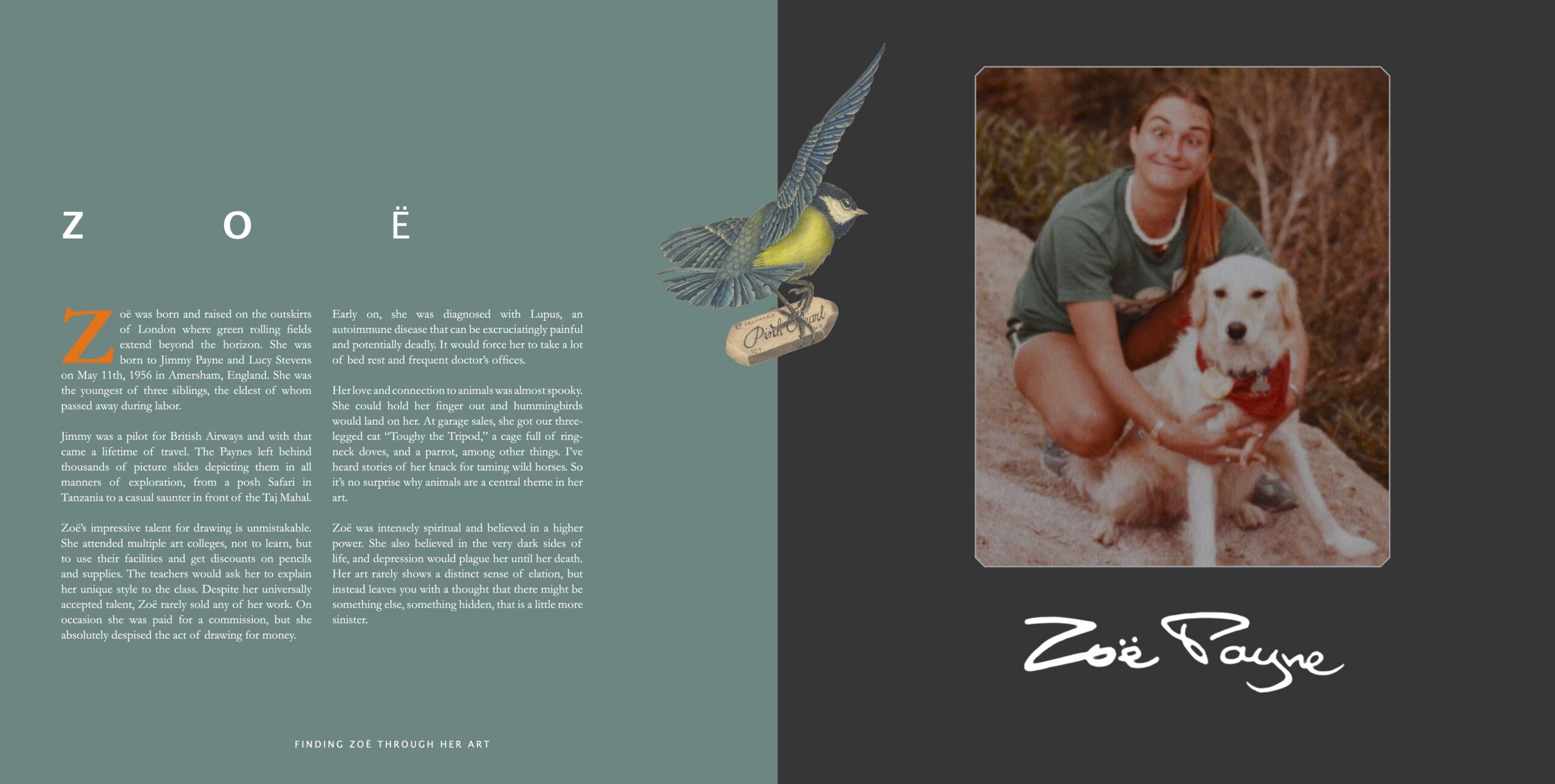
Zoë was born and raised on the outskirts of London where green rolling fields extend beyond the horizon. She was born to Jimmy Payne and Lucy Stevens on May 11th, 1956 in Amersham, England. She was the youngest of three siblings, the eldest of whom passed away during labor.
Jimmy was a pilot for British Airways and with that came a lifetime of travel. The Paynes left behind thousands of picture slides depicting them in all manners of exploration, from a posh Safari in Tanzania to a casual saunter in front of the Taj Mahal.
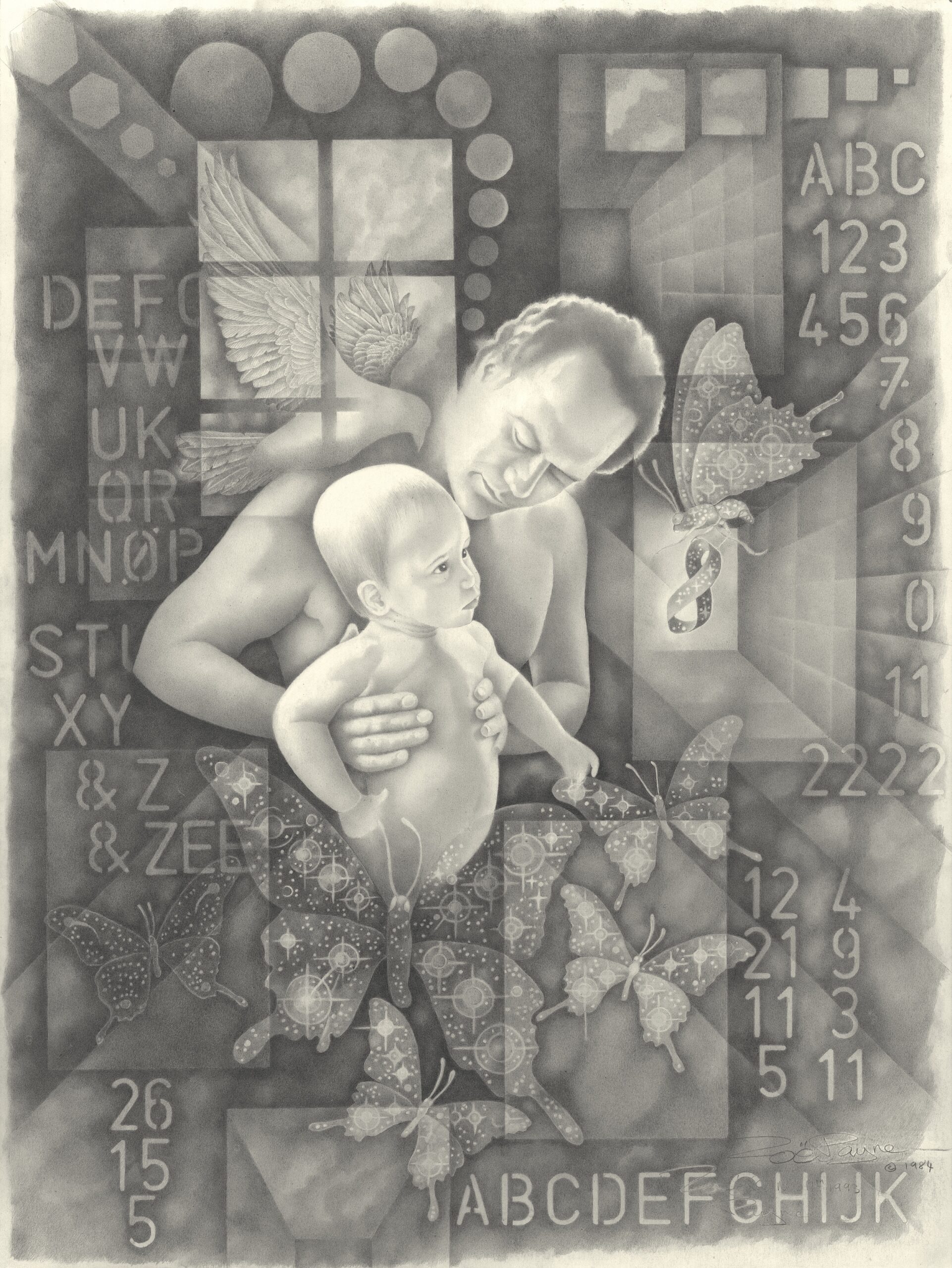
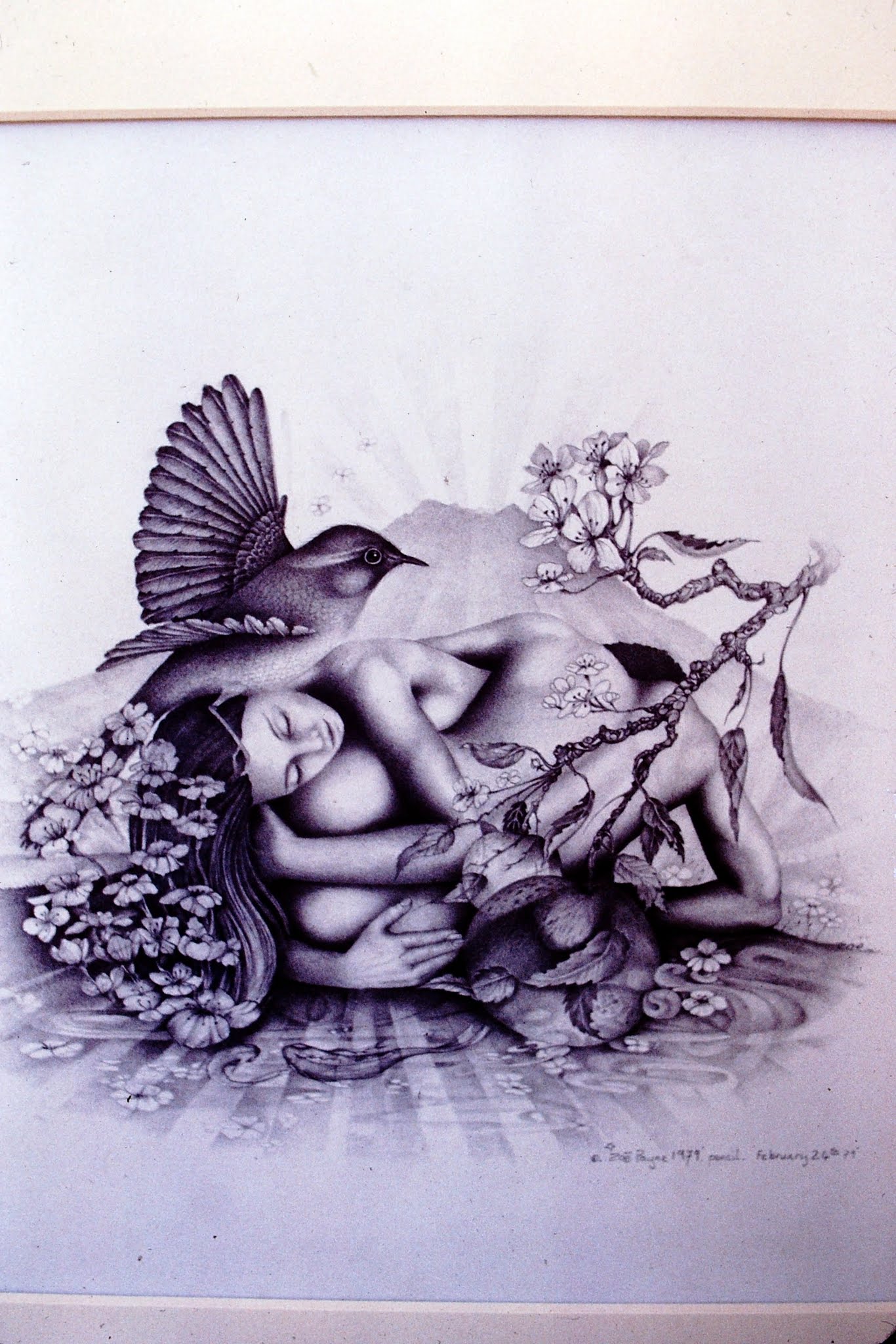
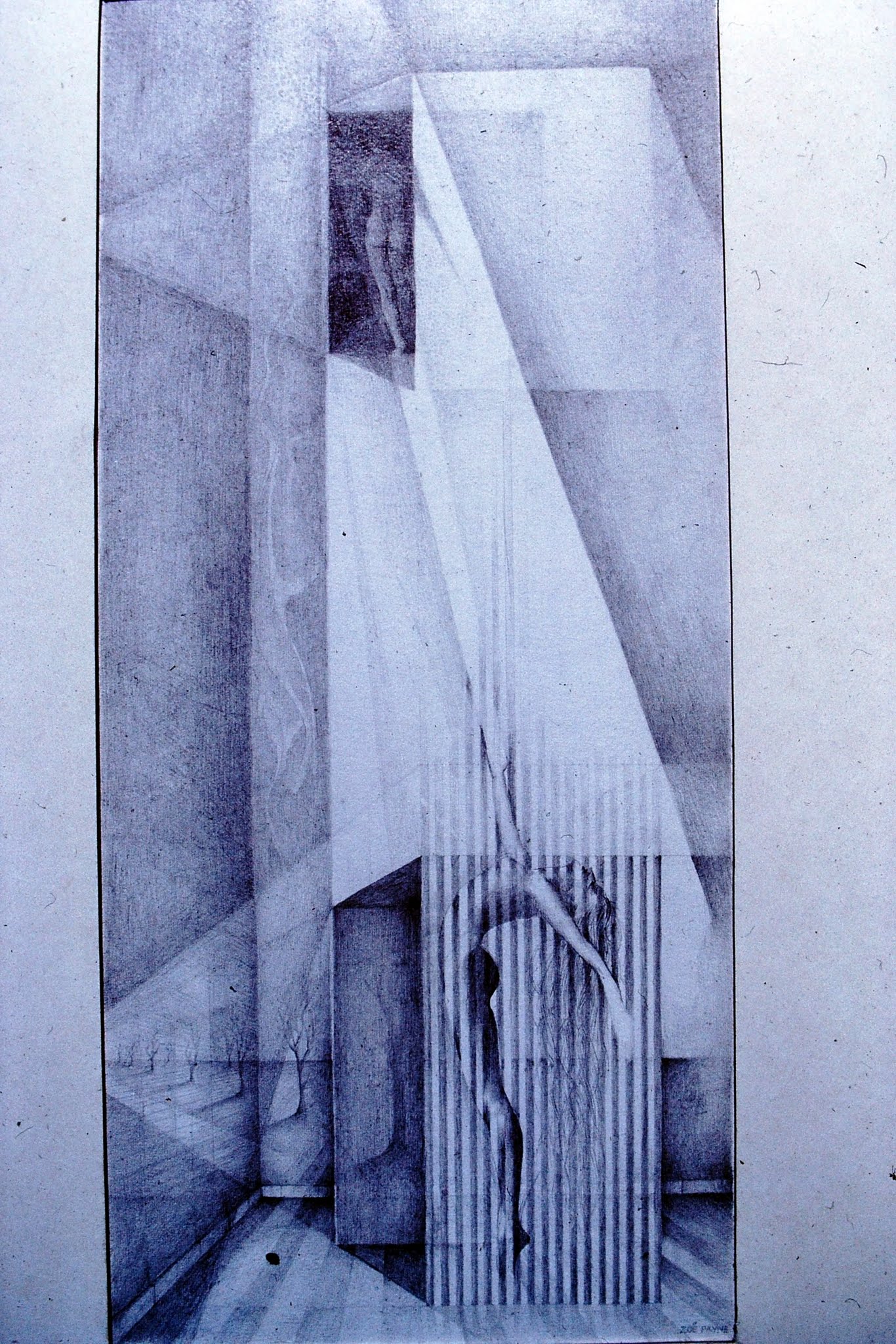
Zoë’s impressive talent for drawing is unmistakable. She attended multiple art colleges, not to learn, but to use their facilities and get discounts on pencils and supplies. The teachers would ask her to explain her unique style to the class. Despite her universally accepted talent, Zoë rarely sold any of her work. On occasion she was paid for a commission, but she absolutely despised the act of drawing for money.
Early on, she was diagnosed with Lupus, an autoimmune disease that can be excruciatingly painful and potentially deadly. It would force her to take a lot of bed rest and frequent doctor’s offices.
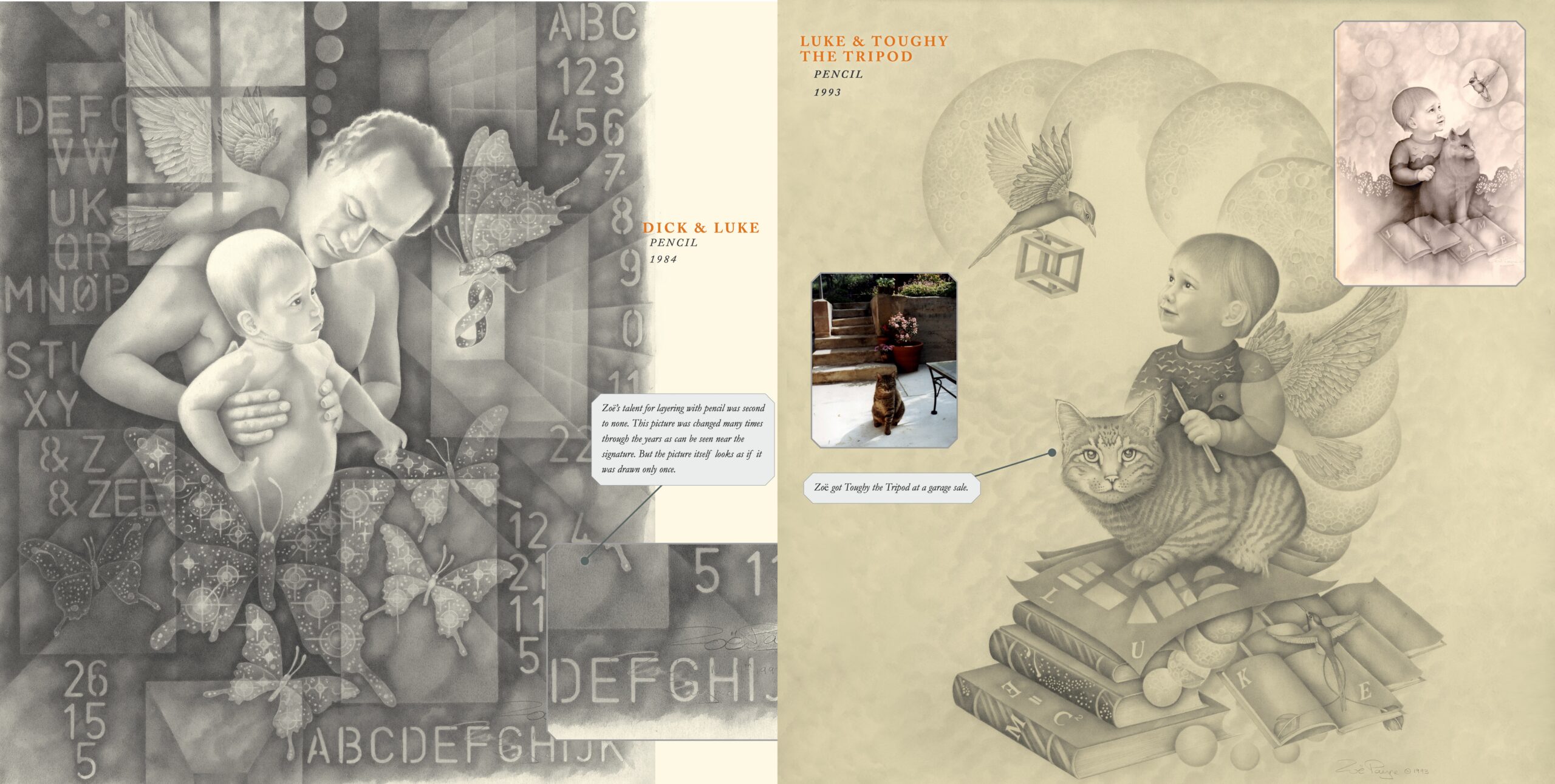
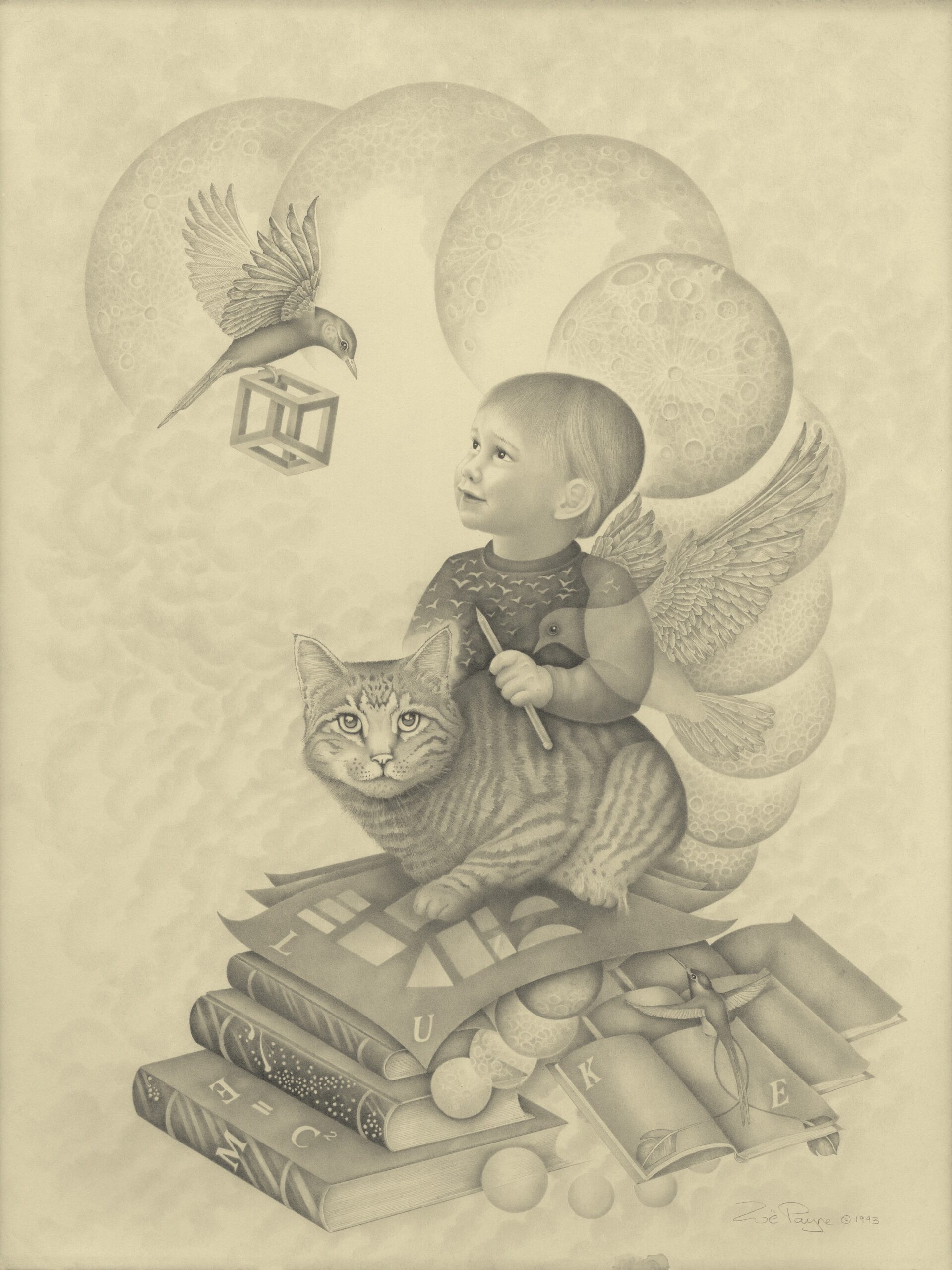
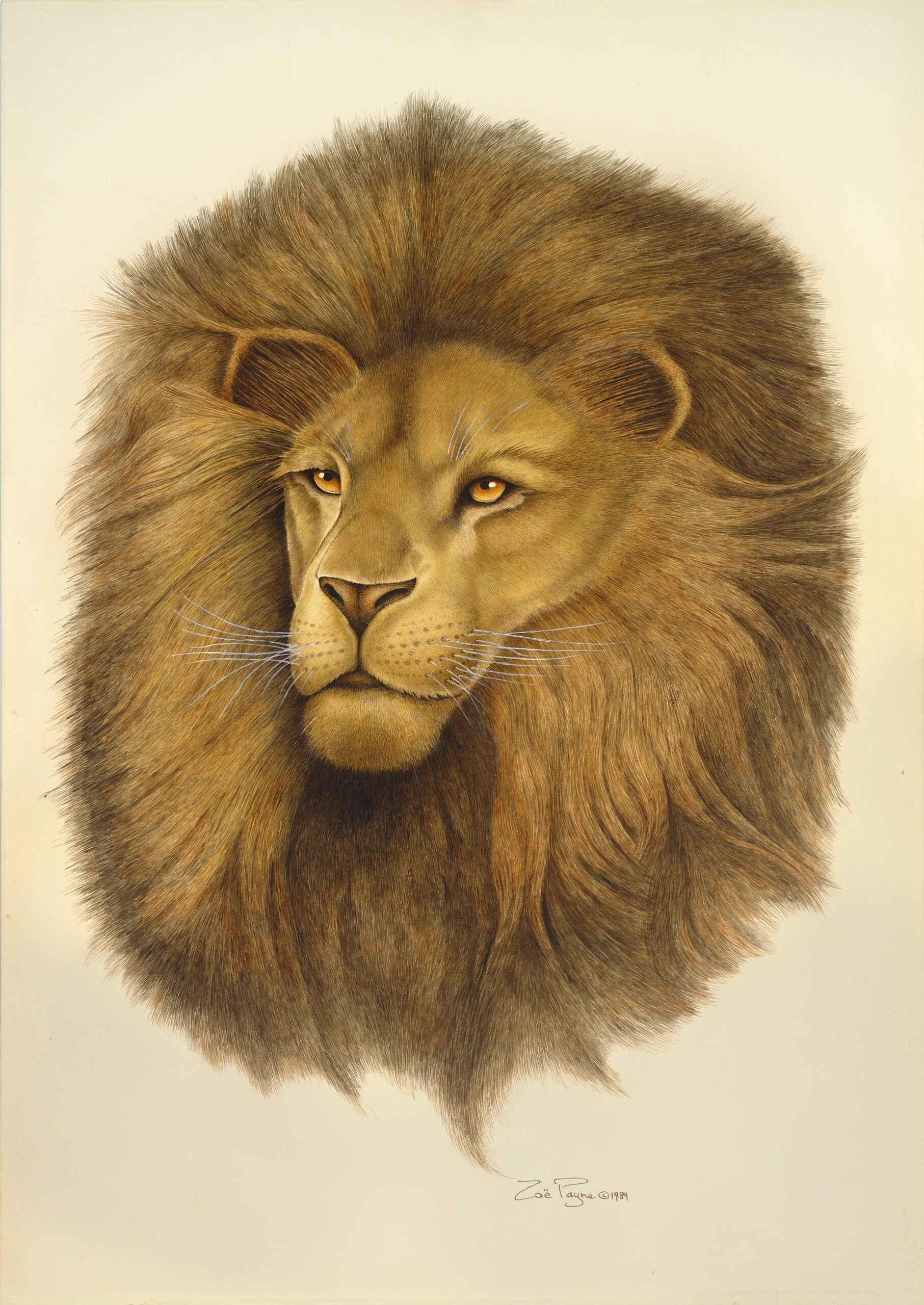
Her love and connection to animals was almost spooky. She could hold her finger out and hummingbirds would land on her. At garage sales, she got our three-legged cat “Toughy the Tripod,” a cage full of ring-neck doves, and a parrot, among other things. I’ve heard stories of her knack for taming wild horses. So it’s no surprise why animals are a central theme in her art.
Zoë was intensely spiritual and believed in a higher power. She also believed in the very dark sides of life, and depression would plague her until her death. Her art rarely shows a distinct sense of elation, but instead leaves you with a thought that there might be something else, something hidden, that is a little more sinister.
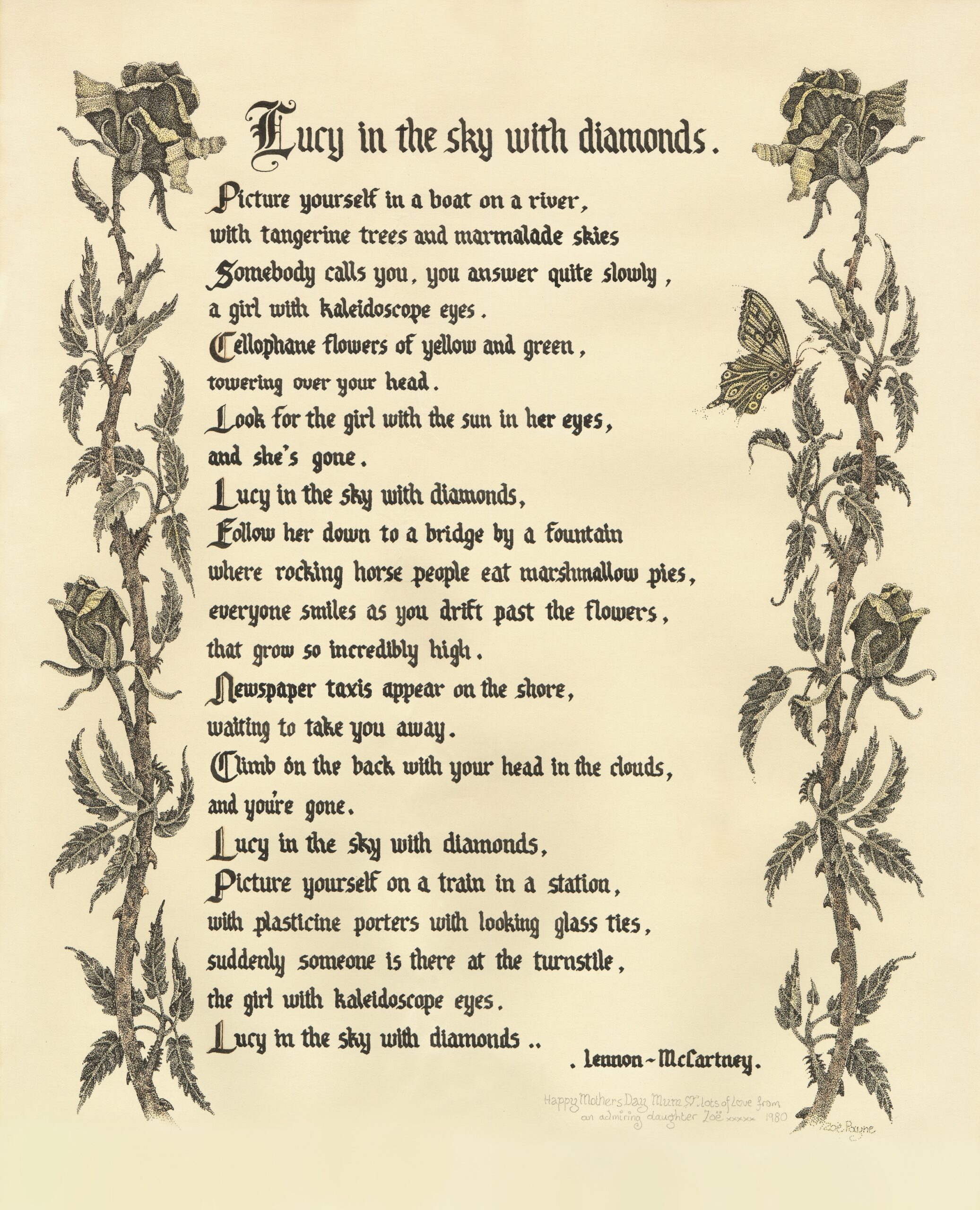
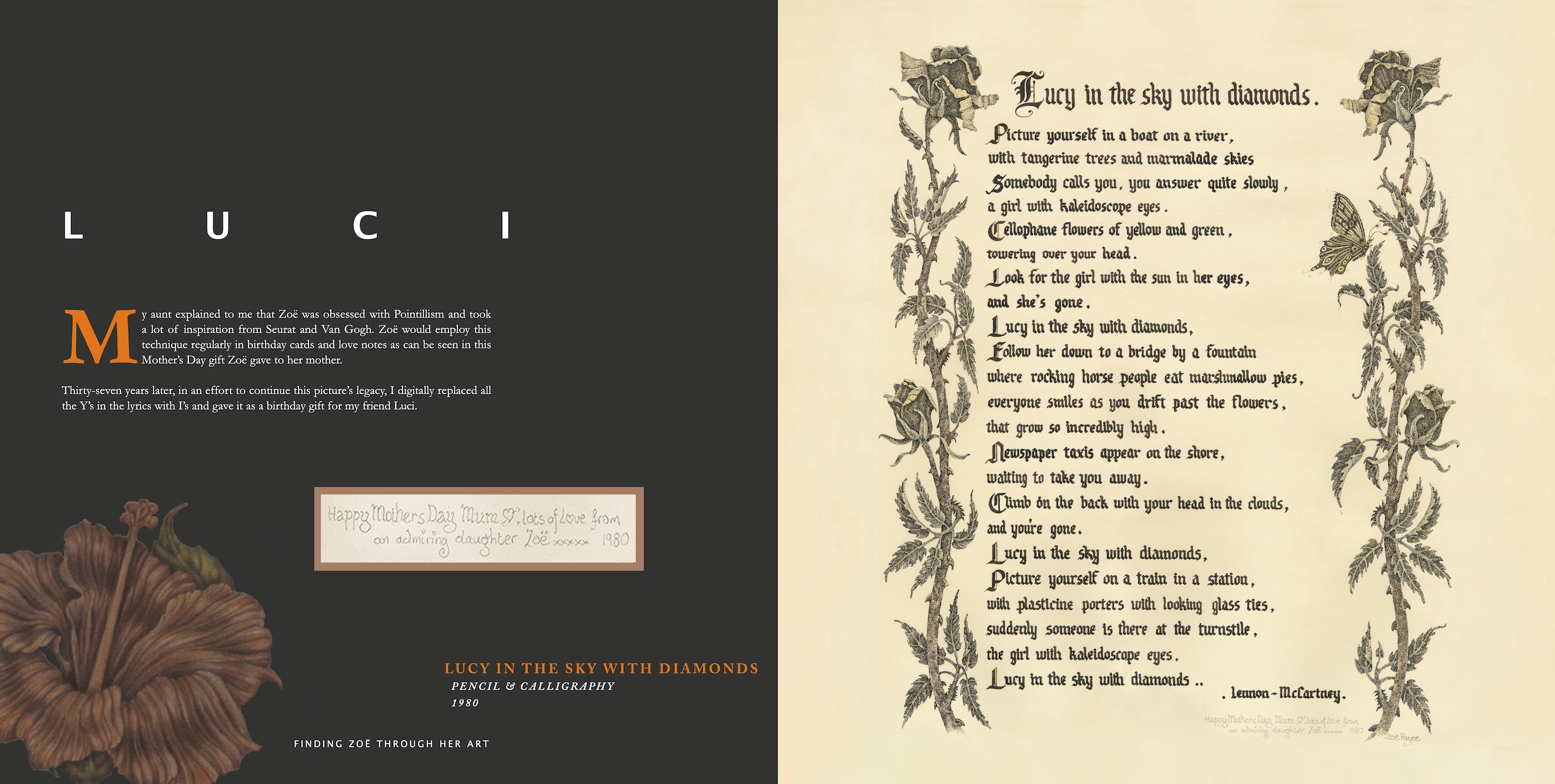
A gift made for one person, repurposed for another, thirty-seven years later. Zoë’s obsession with Pointillism shows in every careful mark — a Mother’s Day card quietly transformed into a birthday gift with one letter changed.
My aunt explained to me that Zoë was obsessed with Pointillism and took a lot of inspiration from Seurat and Van Gogh. Zoë would employ this technique regularly in birthday cards and love notes as can be seen in this Mother’s Day gift Zoë gave to her mother.
Thirty-seven years later, in an effort to continue this picture’s legacy, I digitally replaced all the Y’s in the lyrics with I’s and gave it as a birthday gift for my friend Luci.
Before Dick, there was Jeff. A ferry to a remote island, large glasses of whiskey, and a plastic container full of handmade cards — each one a window into a version of Zoë that Luke had never known existed.
When my grandfather died and we were cleaning out his house, we found pictures of Jeff, Zoë’s ex-husband before my dad. Nobody had a lot to say about Jeff when I inquired, just that he was “a good guy,” and “definitely handsome,” and how he’d “got into some sort of accident,” and how “while he was in the hospital, he and Zoë divorced.”
I emailed Jeff requesting to stay with him for a few days, despite having not a clue where he lived. He agreed and directed me to San Juan Island in the Puget Sound just south of Vancouver — a place where orcas go to play, and where the principal mode of transportation is driving your car onto a big boat.
I arrived late and booked an Airbnb in a town an hour north of Seattle. My AirBnB was hosted by Lisa, and my room was a closet underneath her stairs which was advertised as “Harry Potter’s Closet.” During my conversation with Lisa, she explained to me how she had just returned from her own quest looking for her original parents before they adopted her, a fact she had only recently learned. I laid in bed that night thinking she didn’t seem happy with what she found on her journey, and I wondered if I could expect the same result.
The next morning after a two-hour drive and a 90-minute ferry, I arrived on San Juan Island. I drove off the dock to find Jeff standing by the side of the road. I had previously looked him up so I had an idea of what he looked like. He had been the owner of a popular vegan restaurant, which made him a town celebrity, and he clearly enjoyed being in the local news.
I picked him up and we headed to the new brewery restaurant in town. There was a sense of calm awkwardness in the air — an entirely unpredictable life situation for which neither of us could prepare for but understood we had to share it for the next few days.
It took us 30 minutes to sit down at the restaurant as Jeff stopped at every table to say hello, or ask about the house, or listen to a prediction of the weather. Jeff had lived in the area for three decades, and his celebrity status was evident. At each table we stopped, he introduced me as his “friend.” Clearly, an easier introduction than “And this is Luke, my deceased ex-wife’s son from the guy she met while I was in the hospital.”
After dinner, we left for Jeff’s house, which was another 30 minutes from the harbor in a remote part of the island. His house was nestled into a hillside with lots of tree cover and not much traffic. A five-minute walk and you were on a cliff overlooking the water towards the Canadian coast.
We were both eager to get on with the matter at hand, so as soon as we settled into his rustic living room, Jeff asked me about my agenda. I told him I had none, nor anything planned, nor did I have any questions. I just wanted to come to meet him and understand a part of Zoë’s life that I knew nothing about. This seemed to calm him down. He took a sip from his large glass of whiskey and began his story.
He told me everything in reverse, starting with his split-up with Zoë and ending with fond memories of courtship and love.
The End as I Understand: One evening Jeff and Zoë, married at the time, were hosting a party at their house. My dad showed up selling cocaine to everyone. Jeff then saw Zoë kissing my dad from across the party. Jeff was enraged and was held back by friends and told to forget about it. Over the forthcoming weeks, Jeff would not let the incident go. Until, with emotions running high, he crashed his motorcycle into a truck while riding recklessly through a canyon. Jeff was hospitalized for six months and had burns covering the majority of his body. While in the hospital Jeff would not permit Zoë to see him. Zoë sent flowers and pictures, and pleaded, but Jeff refused to let her see him, resolving to use the hospital as a means to break away. Which is exactly what happened. Zoë moved on, eventually becoming closer with my dad, and she and Jeff split up.
I suddenly realized I had shown up probably looking an awful lot like my dad would’ve when Jeff saw him kissing Zoë. At one point, quite selfishly, I thanked him for breaking up with Zoë, as that decision had the direct result of me coming into existence.
Jeff indoctrinated me with two things he now lives by:
You don’t owe me anything. His hospitality, for example, did not need to be repaid.
Don’t feel bad. I told him I felt bad for drinking all his whiskey and brought him a new bottle. He said he wouldn’t take it because I felt bad. So I re-stated my offer such that it made me feel good to complete the circle of life by giving him that bottle. I found it very satisfying.
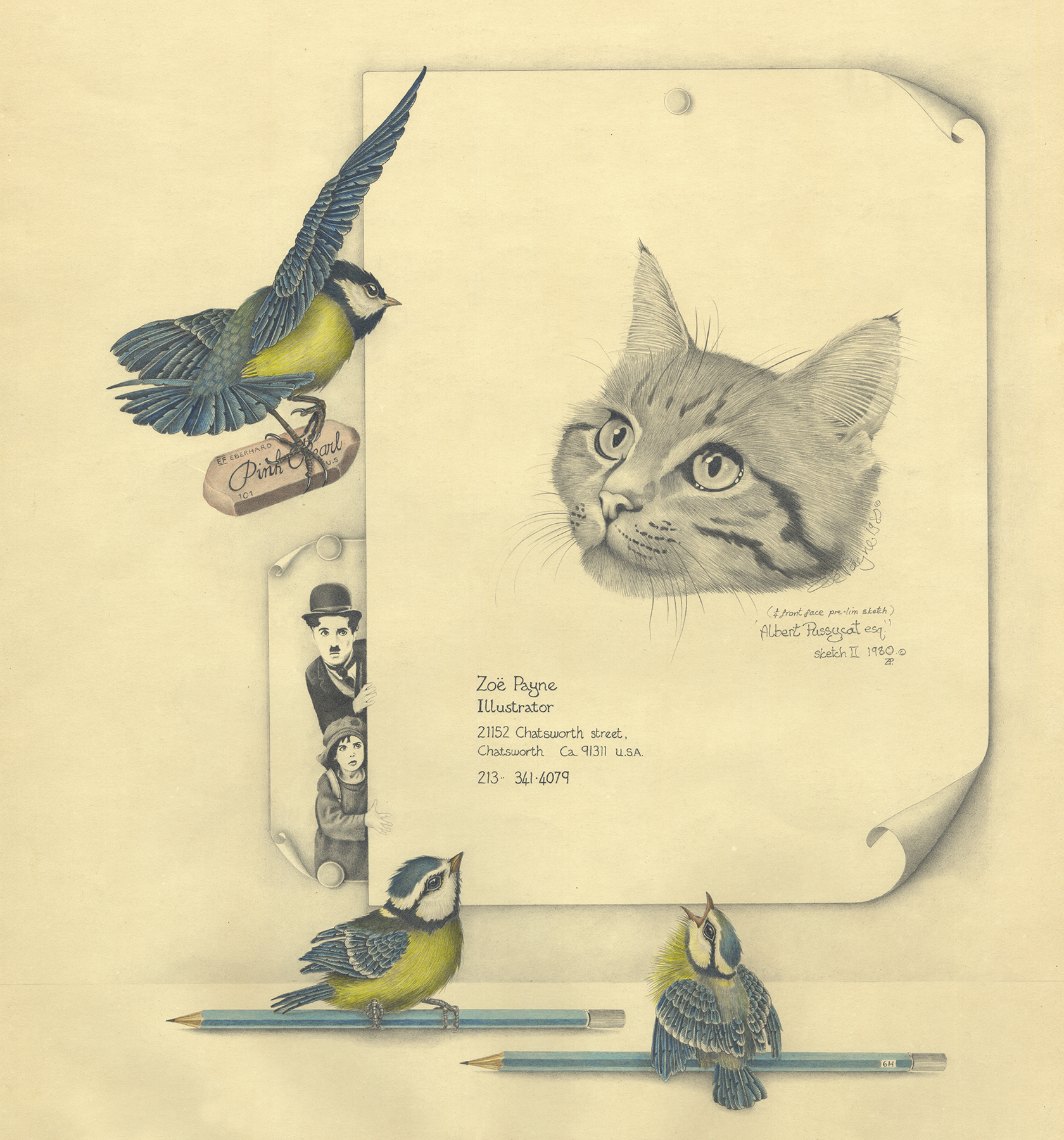
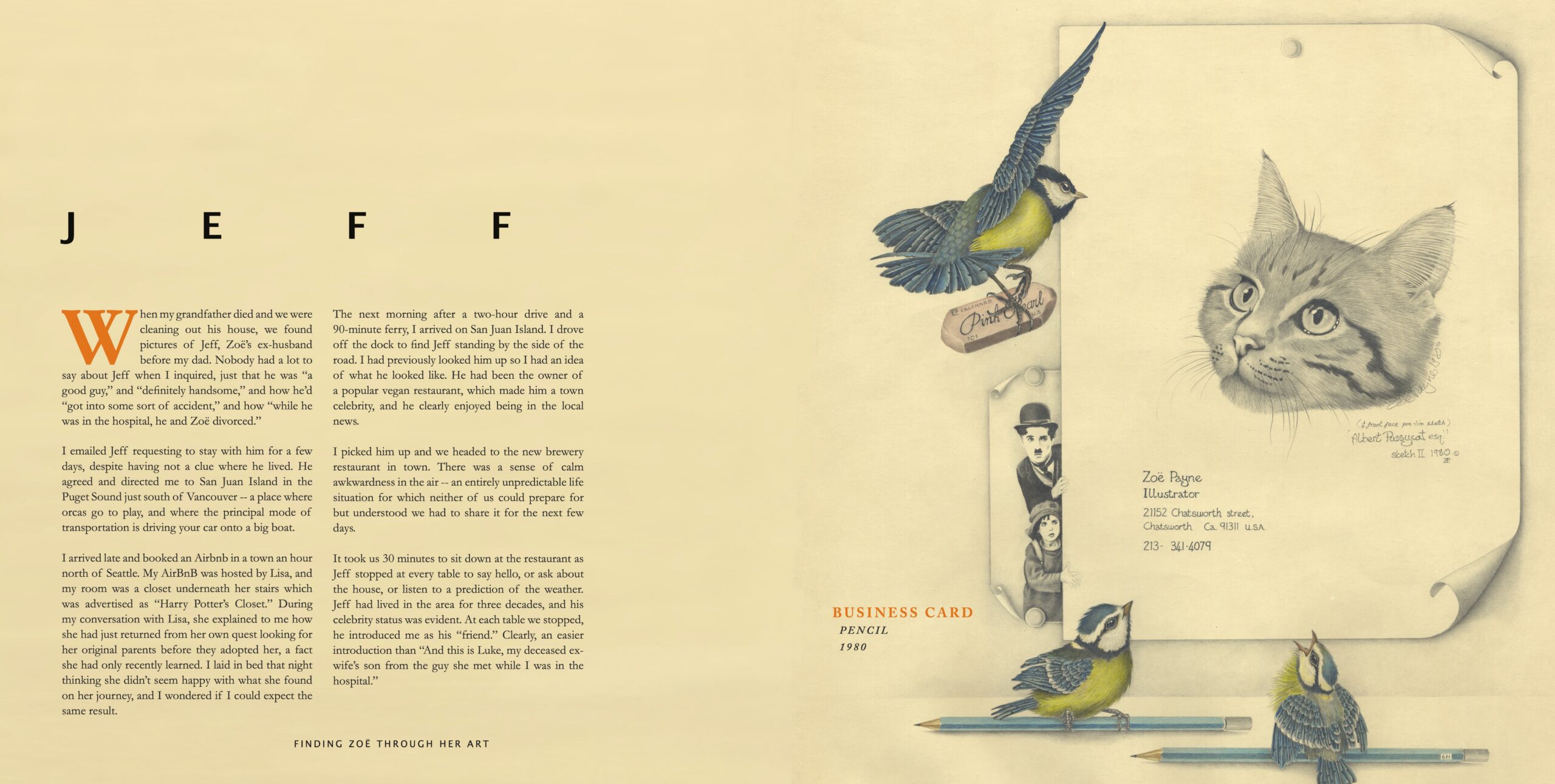
Jeff & Zoë’s Beginning: Over the course of a few days, Jeff would tell me the most beautiful stories of their relationship. How he first knew he was in love with her when they clasped hands while riding their horses mid-gallop. Or how you can still see their initials in the cement at the address on her Business Card picture. Or how she could call their crow and it would fly down and land on her shoulder. He would tell me these stories with a glimmer in his eye and a smile as those beautiful experiences were found in a distant corner of his mind.
Jeff’s stories put me in a state of wonder. To hear about Zoë as a young adult. Not my mother, but a bohemian artist who partied hard and did drugs and loved to throw punches… who lived many lives before the one I shared with her.
One evening, during a particularly emotional conversation, Jeff pulled out a giant plastic container that was filled with cards that Zoë had made while they were together. A postcard-size drawing of Jeff sitting outside at their house while Zoë gazed out the window. Another postcard with stars and incredibly detailed creatures surrounding immaculate calligraphy saying that she loved him and that was all. There must have been at least 200 cards in this container. After reviewing only a few, I could sense Jeff reliving each moment as he pulled out a card. A visual time capsule in a world drawn with colored pencils. I soon realized these cards were personal to him, and sensing his discomfort, I asked him to put them away.
There are some parts of Zoë that I should not expect someone to share with me.
There are some parts of Zoë that don’t belong to me.
The morning I left, Jeff was already out of the house. We had said half-drunken goodbyes the night before, which seemed appropriate.
I left Jeff a print of the Golden Eagle. Right next to the plastic container with the cards.
The print shop worker who named the picture. The word he chose changed everything Luke thought he understood about the year before his own birth. This is one of the shortest chapters — and one of the most striking.
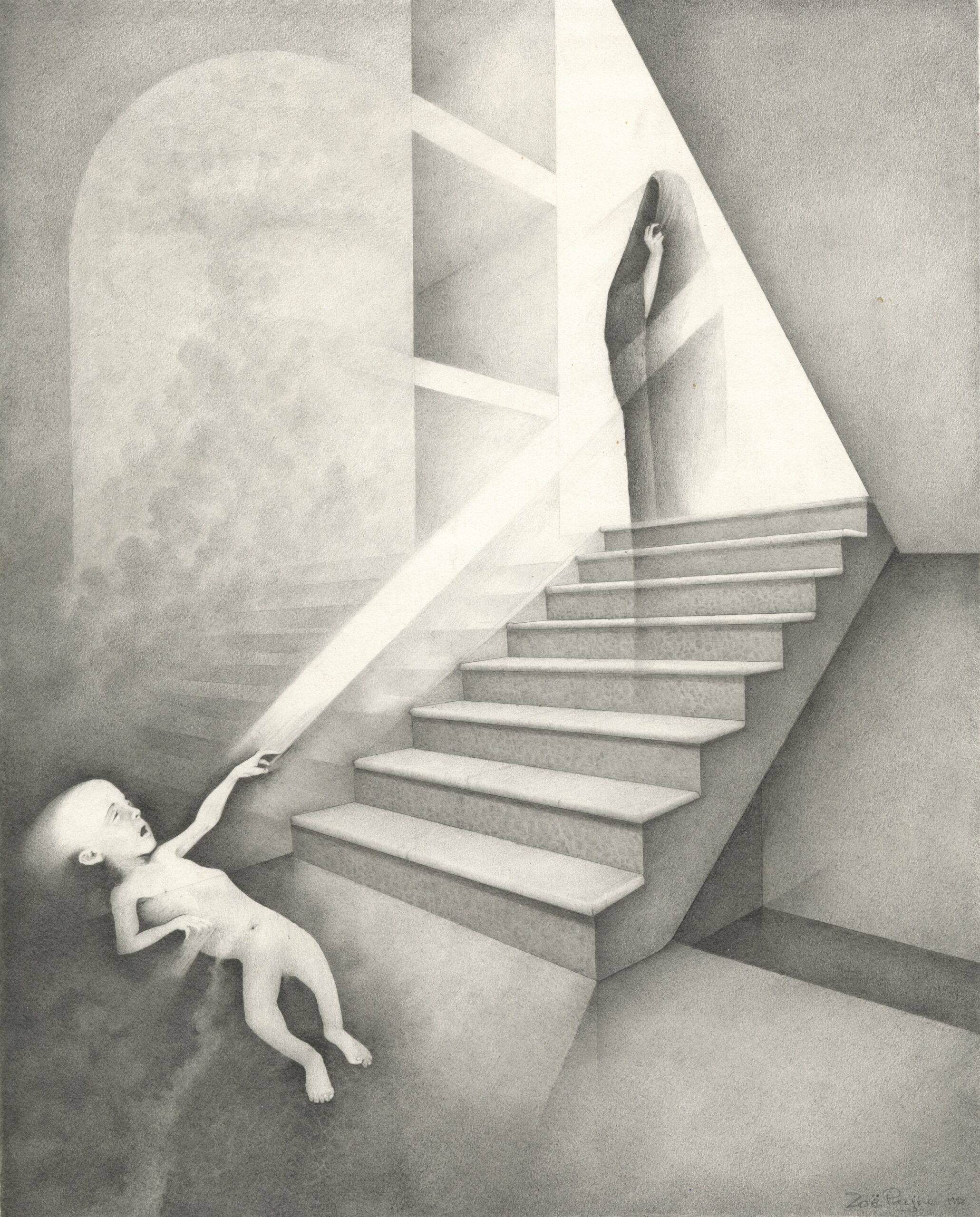
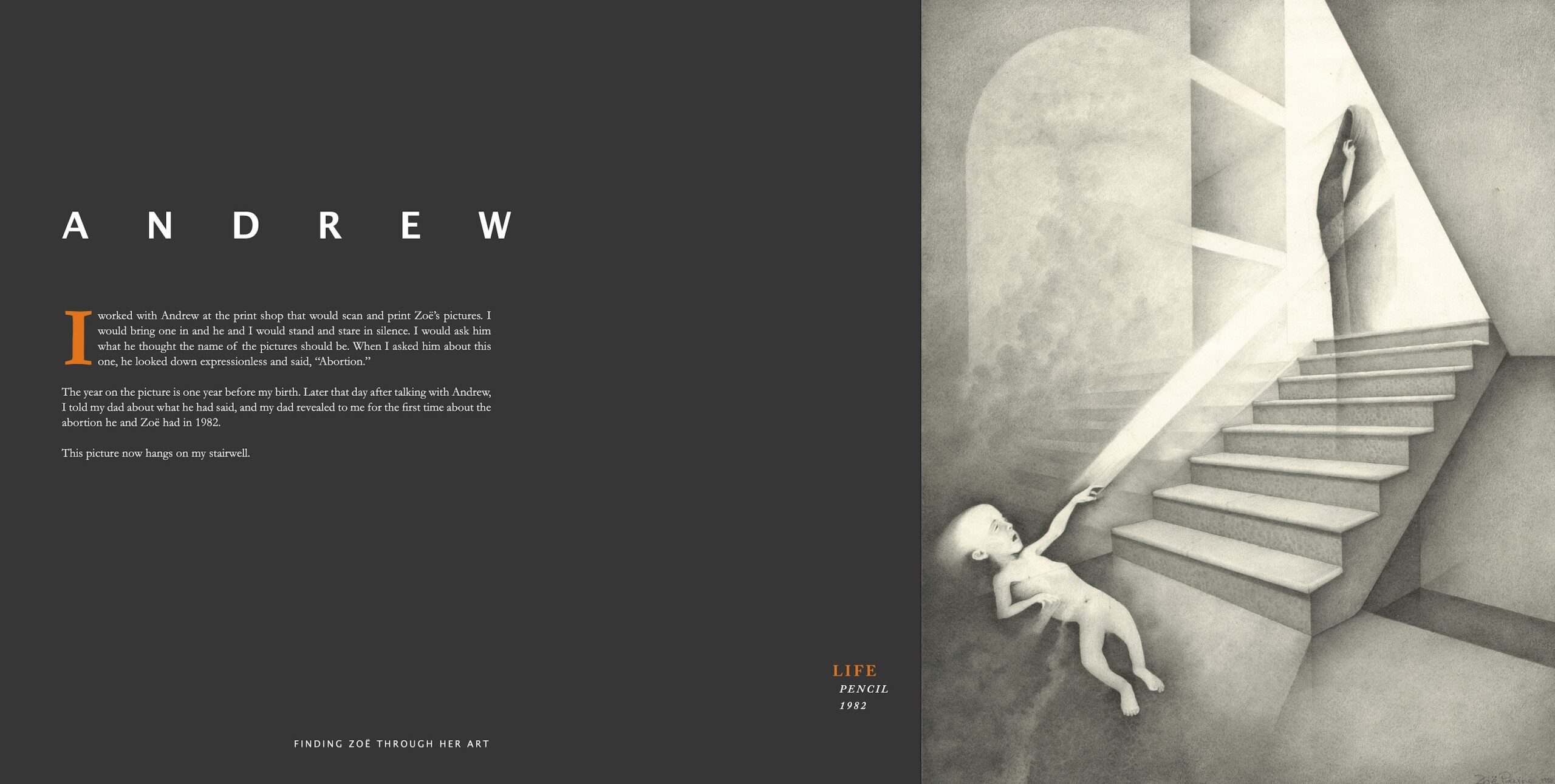
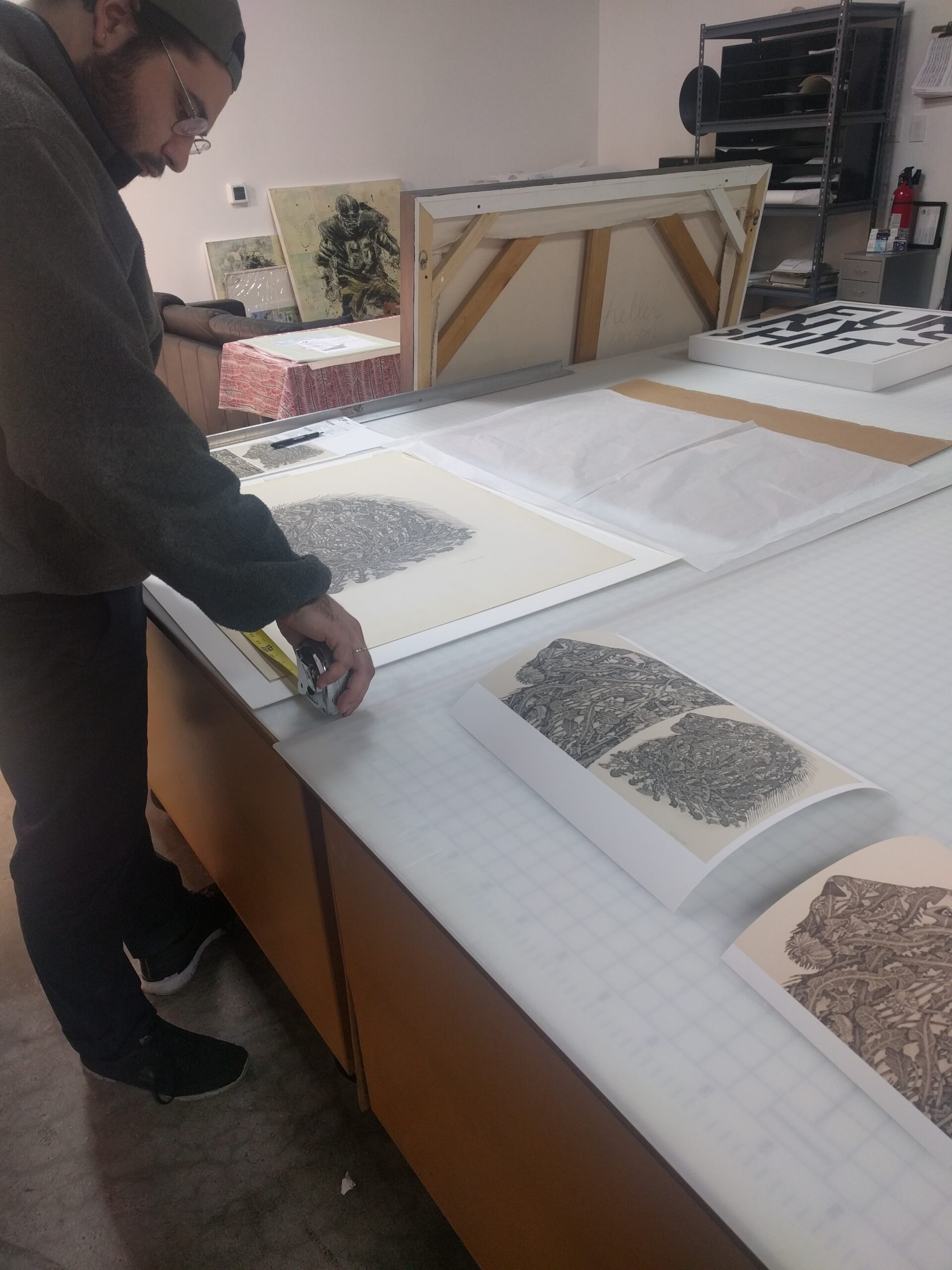
I worked with Andrew at the print shop that would scan and print Zoë’s pictures. I would bring one in and he and I would stand and stare in silence. I would ask him what he thought the name of the pictures should be. When I asked him about this one, he looked down expressionless and said, “Abortion.”
The year on the picture is one year before my birth. Later that day after talking with Andrew, I told my dad about what he had said, and my dad revealed to me for the first time about the abortion he and Zoë had in 1982.
A wedding gift that its recipient couldn’t bear to look at. Hidden behind another picture in the same frame for decades — until Batman’s daughter found it and reached out to send it back.
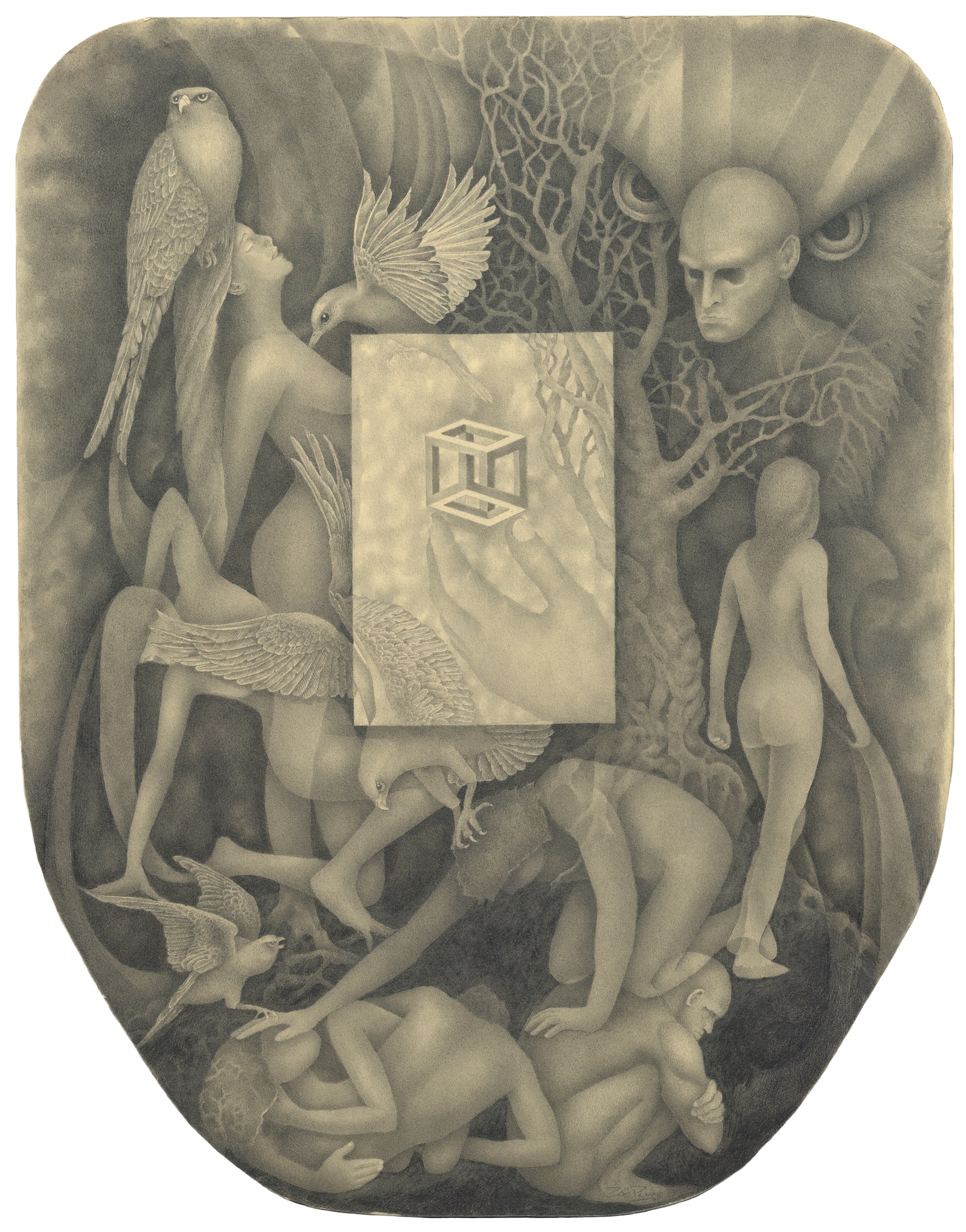
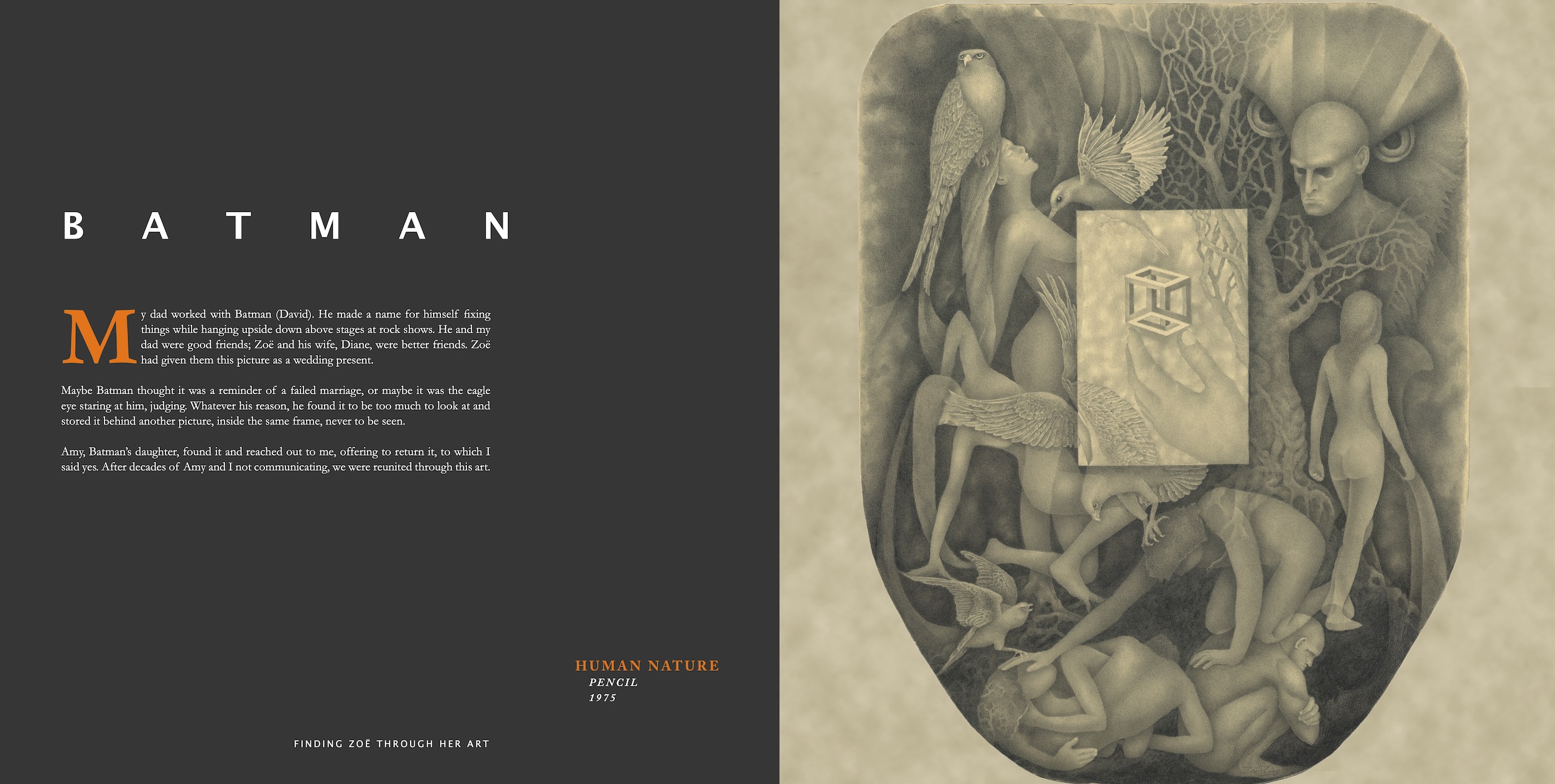
My dad worked with Batman (David). He made a name for himself fixing things while hanging upside down above stages at rock shows. He and my dad were good friends; Zoë and his wife, Diane, were better friends. Zoë had given them this picture as a wedding present.
Maybe Batman thought it was a reminder of a failed marriage, or maybe it was the eagle eye staring at him, judging. Whatever his reason, he found it to be too much to look at and stored it behind another picture, inside the same frame, never to be seen.
Amy, Batman’s daughter, found it and reached out to me, offering to return it, to which I said yes. After decades of Amy and I not communicating, we were reunited through this art.
After two years and fifteen people, Luke returns to the question he started with: who was his mother? This final chapter is not an answer — but it is something better than one.
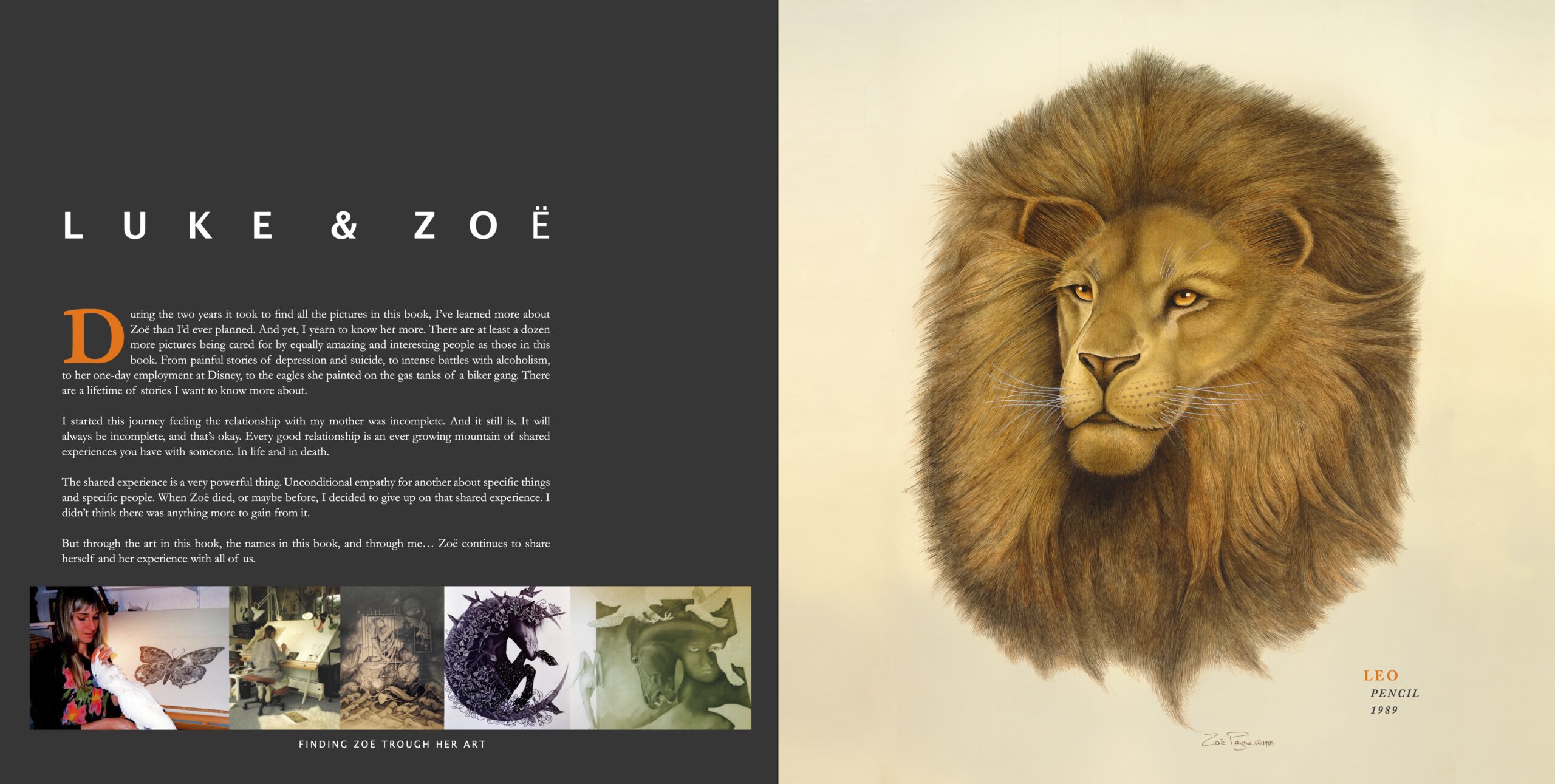
During the two years it took to find all the pictures in this book, I’ve learned more about Zoë than I’d ever planned. And yet, I yearn to know her more. There are at least a dozen more pictures being cared for by equally amazing and interesting people as those in this book. From painful stories of depression and suicide, to intense battles with alcoholism, to her one-day employment at Disney, to the eagles she painted on the gas tanks of a biker gang. There are a lifetime of stories I want to know more about.
I started this journey feeling the relationship with my mother was incomplete. And it still is. It will always be incomplete, and that’s okay. Every good relationship is an ever growing mountain of shared experiences you have with someone. In life and in death.
The shared experience is a very powerful thing. Unconditional empathy for another about specific things and specific people. When Zoë died, or maybe before, I decided to give up on that shared experience. I didn’t think there was anything more to gain from it.
But through the art in this book, the names in this book, and through me… Zoë continues to share herself and her experience with all of us.